Hi-tech remote patient monitoring set to revolutionise care
LONDON: A computer specialist whose hi-tech artificial intelligence work in healthcare was inspired by Iron Man has asked for a laboratory spot in the Cairns University Hospital.
The Cairns Tropical Enterprise Centre already has highly skilled experts lining up for laboratory space despite the project still lacking a home.
James Cook University PhD student Stephanie Baker is in the final stages of her doctoral thesis on using artificial intelligence in healthcare — a field with enormous implications for remote patients.
She attended Redlynch State College but shifted to Townsville for university and has remained there since.
The computer systems engineer was inspired to enter the field by her father, as well as a very popular superhero.
“Dad was always telling me that engineering would suit me, but I had my doubts. Then I watched Iron Man and realised that if I had a computer engineering degree I could build J.A.R.V.I.S.,” she said.
Ms Baker has not yet built the movie franchise’s artificially intelligent butler but her research into remote monitoring of patients does have potential to save lives.
“When my great grandmother was in her 90s and living an hour from town, she had this device — if she fell over she could press a button and it would call an ambulance,” she said.
“It completely depended on her being able to press that button, which isn’t always possible if someone’s injured or unwell, so it got me thinking about ways to improve it.
“Could we make a device that would monitor multiple factors of someone’s health and call an ambulance automatically if something went wrong, with no button pressing required?”
Ms Baker’s thesis looks at measuring both blood pressure and respiratory rate using machine learning, and her research could have wide uses for patients in the Torres Strait, Cape York and beyond who cannot always attend hospital.
“This would enable patients to have their health monitored comfortably and continuously, either at home or in hospital. I would love to see this technology used not only in remote areas,” she said.
It could also allow patients to return home earlier and still be monitored, thereby freeing up hospital beds.
The federal government has committed $60m towards the CTEC component of the Cairns University Hospital, but another $165m-plus in state funding is required to get the whole project off the ground. By that stage, Ms Baker will be Dr Baker.
“Keep some benchspace for me. My work with the ICU database has allowed me to get this far, but I would really like to take my algorithms and devices to clinical trials here in Australia,” she said. “I’m also really eager to apply what I know in other adjacent fields, like epidemiology.”
-
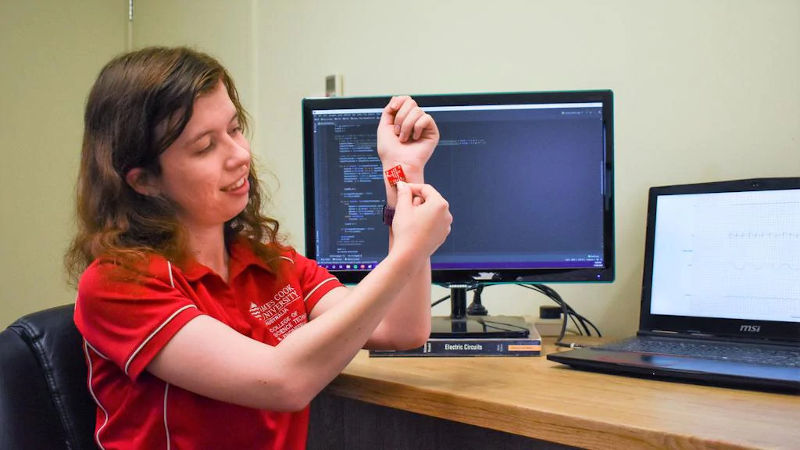
- JCU engineering student Stephanie Baker with a circuit board for her non-invasive, constant monitoring device.