Older people finding new ways to carve out communities

LONDON: The paucity of options on offer from traditional over 50s housing providers has driven older people to create their own communities.
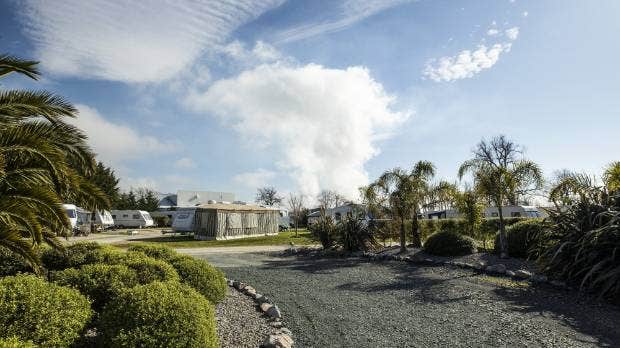
Ruth Upsom lives at the Queen St Holiday Park in Richmond. She also owns her home, but wants to stay at the holiday park because of the community it has.
Last year, Ruth Upsom bought a house. She put her caravan on the market and prepared to move into a quiet Richmond street.
But she changed her mind. “I thought; ‘No, I’ve got so many friends here. Why would you go somewhere where you don’t know anyone?’.”
Upsom has lived at Queen Street Holiday Park in Richmond for two years. When she moved in she found a ready-made community where everyone knows her name, and everyone wants to chat.
“There’s always someone about. I’ll go for a walk around the camp and it will take me an hour.”
Currently, about one in four New Zealanders live alone. By 2038, this will increase to one in three. By the same year, one in three people in Nelson-Tasman will be over 65.
Research shows almost half of older New Zealanders experience a level of loneliness, with nearly one in 10 feeling lonely all or most of the time.
As a single person, Upsom likes the fact she’s surrounded by people.
“It’s frightening for me going into old age on my own. Living here, if I had a heart attack at least someone would notice if I wasn’t around.”
Upsom’s neighbours come from all walks of life and have a wide array of skills. There’s always someone around to help with a flat tyre, a hedge trim, or an extra meal when someone’s in need.
And there’s always something to do: Friday evening drinks, rock ‘n’ roll dancing events and patio gatherings.
Some think of caravans as holiday accommodation, but with its colourful throw cushions and flowers, Upsom’s is a home. Outside, she has a deck with a table and chairs, and grows flowers and lettuce.
Upsom plans to stay at the park “until I’m really doddery”.
“I had never in a million years imagined living like this, but now I choose to live here because I like to live here.
“I have had to start again a few times, and this is a good place to do it.”
Dr Hamish Jamieson, an Otago University medical specialist who studies ageing, says older people living alone can suffer poorer health, including more breathlessness and chest pain.
Living in a community gives people a sense of esteem and identity, a greater purpose in their life.
“Having people around provides reassurance and pragmatic support; people who are with others generally have better outcomes for their well-being.”
Eco community
Lindsay Wood’s home at Nelson’s Braemar Eco Village is an experiment that’s never been finished.
The former eco-architect designed it himself, wrapping the home in recycled cladding and insulation, powering it with photovoltaic panels on his roof. He’s still honing the passive heating system, but the composting toilet works fine.
“You always have things you want to try but don’t want to inflict on a client.”
Born in 2008, Braemar is now a fully fledged community of people in nine homes arranged over a sloping 4.4 hectare plot beneath the Grampians.
The residents are a mix of tenants and homeowners, young families and retirees.
“We share core values, but we’re not all the same,” Wood says.
Their common ground is the land, which everyone works on together. Once a month, they meet for a working bee, a chance to put a dent in a big job and catch up.
Their “light but fairly regular social calendar” includes potluck dinners and Christmas parties, Wood says.
“There’s a low level of socialising. We get on well together, we look out for each other without being in each other’s pockets.
“But if someone’s having a tough patch the word gets around: can we give a bit more support to so and so.”
Wood is keen to point out that life at Braemar isn’t a group of people pottering about in the country.
“There’s a lot of physical work.”
Wood gave up his work as an architect a decade ago to concentrate on climate change strategy: he researches, writes, gives talks and consults.
Climate change resilience was front and centre of Wood’s desire to help grow Braemar.
“We need to think about how we will live as communities. I don’t necessarily mean a bunch of us like this, but having strong communities will be more and more important as things get tougher.
“I thought, I owe it to my grandkids to do everything I can.”
Having older people around is positive for everyone, Dr Hamish Jamieson says.
“It’s good for children to have older people around, they have knowledge and wisdom to pass on.”
But multigenerational living arrangements are increasingly rare, and the rules around building is making them less likely.
“New subdivisions preclude the building of a granny flat, it’s simply not allowed,” he says.
Conversations needed to be had at all levels of society about how older people will live as the population ages, and how we will develop our urban spaces to accommodate everyone, Jamieson says.
“We have got into this notion of living … this dream of a quarter acre section and a high fence. Then when they get older, people want to downsize and have people around them.”
For more than 40,000 older New Zealanders, this now means a retirement village.
While these communities were a positive way for older people to live and connect, they are expensive, Jamieson points out.
‘Flatting for seniors’
With residents paying $347 a week including food, Abbeyfield Motueka is a low-cost alternative to a retirement village.
Jean Thomas is one of Abbeyfield’s newest residents. Until recently, Thomas had rented a home where she lived alone, but her daughter encouraged her to apply for one of the 10 Abbeyfield units.
“It’s wonderful here,” Thomas says. “It’s been a big adjustment, but not traumatic.”
Her new neighbours were friendly and interesting, Thomas said. “A lot have travelled overseas and have stories.”
Like her next door neighbour, Cadia Bevan, who is leaning on her walking frame and feeding the birds on the lawn. For a long time, she worked as a missionary in Bangladesh, Pakistan and Nepal.
“I have a gift of healing,” she says. “I’m hoping to get back into it but people have to believe for it to work.”
There are 10 residents at Abbeyfield Motueka. The not-for-profit billed as “flatting for seniors” that started in the UK has spread around the world. Of the 14 Abbeyfield homes around New Zealand, four are in the Nelson-Tasman region.
Thomas and Bevan wax lyrical about the meals: wholesome, plentiful, and prepared by a cook.
“The food is wonderful here,” Bevan says. “That’s why we’re all so well.”
The residents are encouraged to eat together in the dining room, part of the Abbeyfield philosophy of getting everyone together. Residents can socialise in common areas – attending happy hours, special dinners and sing-alongs – or retreat to their rooms for some private time.
Abbeyfield Motueka chair Geoff Milnes says the complex runs on a shoestring budget, relying in part on community donations of food and other items.
There’s no lower age limit, and the youngest resident to move in was 55. However, applicants must complete an interview, a medical assessment, and a two-week trial.
“It’s not for everyone,” Milnes says.
But those who do stay, tend to remain until they can’t manage an independent life, he says. For some, it’s their final destination.
Miles cites a former resident who told him moving to Abbeyfield would be his last move.
“And that’s what happened. He lived here until he just quietly gave it away.”