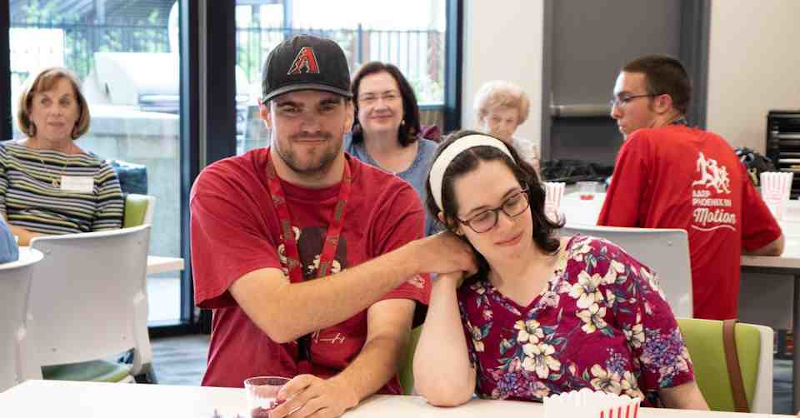
How one mother built residential community for her son

LONDON: A mother has built a residential community that will benefit a cluster of families facing care challenges.
When I began interviewing leaders in assisted living for my project, What Will You Do When I’m Gone, I always asked at the end, “Is there anyone you think I should interview?” One person’s name came up over and over: Denise Resnik. I was told that this was a woman who had not only created an admirable model for residential living for people with disabilities but was also someone who wrote about her successes and failures freely, lectured widely, networked constantly, and advised broadly.
I had not prepared for our interview, so when I called her, she spoke with restrained impatience, telling me she had meetings lined up one after another; I was the bumbling, uninformed writer/father while she was the driven developer/advisor/mother in perpetual motion. She asked if I had read her blog or looked over her work, and when I answered in the negative, she suggested we speak at a later date. However, she was intrigued by my project, so we wound up talking much longer than expected. I admitted that I didn’t know much about building a residential place or even what made a good one, but Denise was patient and considerate in her answers, even when I pressed her on affordability for those with lower and middle incomes.
I discovered her motivation was like mine—born out of a need to find a lasting place for her son, Matt. When Matt was diagnosed with autism, the doctor advised her to “love, accept, and plan to institutionalize him.” Horrified by what she saw in the institutions, Denise leaned into her background in real estate and set out to build First Place AZ, a $15 million, mixed-use residential property located in the heart of Phoenix, Arizona, one of the most autism-friendly cities in the United States. Her residential building has been featured in numerous magazines and in a segment on PBS Newshour.
The following eight lessons are a combination of our interview and her own writing, designed to help people looking for a residential community or hoping to develop one of their own.
1. A residential community connects with the broader community.
- Get out of the “silo mentality” of creating a residential community for a specific age group and disorder. The more diverse the living environment, the richer the experience.
- Create space based on needs, interests, and strengths. That’s when you’ll see real change and growth.
“This past weekend, a few of us, my son included, walked to the light rail and hung out at the bowling alley. Another group took a morning hike at a nearby mountain preserve and later that day went on a trip to the Musical Instrument Museum. Last week, another group went to see the Phoenix Suns play. Not every activity is right for everyone. What’s important is that people can choose what they’re interested in and explore new interests.”
- Building community support is essential.
- Connect with as many government housing and service agencies as possible. Get them talking to each other.
- Connect your residential community with the community-at-large.
“One way we reach out is by spending a lot of our time connecting to arts and culture organizations so people can start exploring their interests. It’s even better if they share these experiences with their non-disabled neighbors and cultivate friendships like going to the theater together. While housing is very important, what people do all day is equally important.”
2. A residential community builds on strengths.
“My first job out of college was with the Del Webb Corporation, the grandaddy of senior housing. At the time, there were few options for seniors. Today, seniors have lots of choices, price points, services, and amenities. Simply being a certain age should not dictate what someone wants or needs in their housing.
“Seniors are all different. Some have health and mobility issues. Others are ready to start crossing off their bucket list. Residential communities for the disabled should also cater to the individual, not the disability. By looking at senior homes, and later successful residential properties, we built upon and expanded on what was already working.”
3. A residential community innovates.
“Jillian and Scott Copeland’s Mainstreet Apartment Community in Rockland, Maryland is really inspiring. Twenty-five percent of the housing units are reserved for people with disabilities, and the remainder is low-cost housing. Their model is inclusive and financially sustainable.”
4. A residential community encourages individual growth.
“Residential living for the disabled should be seen like senior housing in reverse. First, nursing and, over time, increasing levels of independence, decreasing their costs, increasing their choices, quality of life, and options where they might go next. For some people, the first place may be where they live for a very long time or forever. But for others, it’ll be where they live earlier in life, build their skills or jobs or friends, and then go on to their next place.”
5. The goals of a residential community should be realistic and attainable.
- Be practical about your vision.
- Research early and thoroughly.
- One size does not fit all. Cast a net that could include everyone based on levels of ability, price points, design preference, etc.
“I’ll never forget my conversation with an 80-year-old mother, who had moved her adult son 10 times and wanted to make sure First Place-Phoenix could be his forever place. She knew this next move might be the last one on her watch. It was stories like that made me really carefully consider my plans.”
6. Don’t fall in love with your plan too soon.
“We realized at one point that the cost of our building was greater than estimated. That’s when we pushed the pause button and took a six-month time-out to re-assess, saving us $3 million from the original project cost.”
-
- First Place AZ residential living for people with disabilities in Phoenix, Arizona