Elderly getting hooked on harmful and family-shattering conspiracy theories
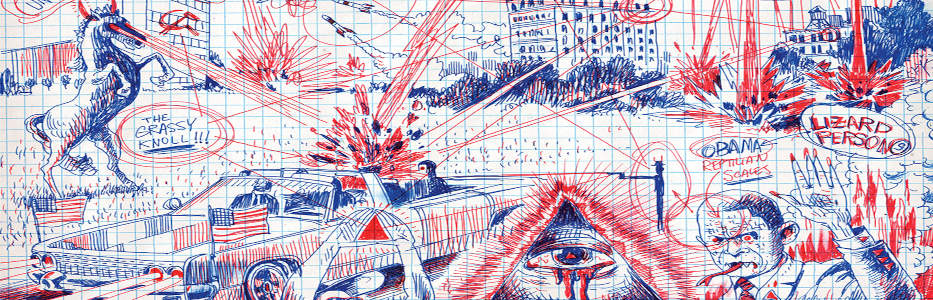
LONDON: The elderly are increasingly falling victim to dangerous conspiracy theories that promote anti-Semitism and other extreme views, much as they are with scams, sparking concern among deradicalisation experts.
In doing so, they’re risking their relationships, sanity and money.
A neo-nazi rally in Adelaide on Australia Day, which included black-uniformed men from WA, reinforced fears about the radicalisation of young men in our communities and the potential for their hate to foment into terrorism.
But in rural towns as well as cities, growing numbers of over-50s are embracing the lunatic rantings of charismatic leaders in the conspiracy movement.
Curtin University’s Ben Rich, an expert on radicalisation, said the trend was contributing to the “breakdown of social bonds necessary for a functional democratic society”.
Whilst retirees are less prone to engage in violence, numerous studies indicate they’re more susceptible to disinformation and tumbling down deep and harmful rabbit holes, wasting their precious retirement years in front of a screen, fixated on crazy theories like QAnon.
A speaking tour of WA by one of Australia’s most nutty conspiracy theorists, Riccardo Bosi, had the four venues filled almost exclusively by older community members.
Bosi, who preaches a mix of QAnon and Sovereign Citizen beliefs, was feted by devotees at Northam, Bunbury, Shenton Park and Merriwa. He urged them to adopt mass non-compliance of rules and defy police, who he said had no real authority.
And just one day after the 80th anniversary of the liberation of Auschwitz last week, he told hundreds of online followers that “it was a lie” that six million Jews were killed in the Holocaust.
In his weekly video to followers, he also claimed doctors were getting paid for the body parts of aborted foetuses and California wildfires were deliberately caused by a “direct energy weapon” .
His channel on right-wing video platform Rumble has 35,000 followers.
The media has previously exposed Mr Bosi, who has repeatedly called for politicians, judges, doctors, journalists — basically anyone who supported the “COVID hoax” — to be hanged.
Mr Bosi’s followers see him as a future national leader. He’s convinced them he has insider knowledge of a secret war being waged by US President Donald Trump and other “white hats” against an evil cabal of Satan-worshipping liberal elites who rule the world, while trafficking children for sex and blood, which they supposedly drink.
His credentials in the QAnon sphere grew when received glowing praise from Mr Trump’s former national security adviser Michael Flynn in 2021.
“When I first saw you speak, I said ‘wow, we got to pay attention to this guy’,” Mr Flynn said.
He also caught the attention of US broadcaster and prominent conspiracy theorist Alex Jones, who invited him on his InfoWars show to discuss Australia’s transformation “into North Korea”.
Mr Bosi’s appeal with older Australians was enhanced by his impressive military resume as a former SAS lieutenant-colonel. After leaving the army he became a motivational speaker on leadership. When not raging, he presents as eloquent and charismatic.
He seeks and receives donations from supporters via his political party, AustraliaOne, which still hasn’t been registered five years after its inception. It doesn’t intend to put up any candidates at forthcoming State and Federal elections. Mr Bosi, who lives in Sydney with his wife Rhiannon, doesn’t appear to have any other source of income.
Conspiracy theories which sow grievance and hatred have wrecked families and friendships. Thousands of personal accounts of relationships destroyed by QAnon, for example, have been shared on a Reddit page called QAnon Casualties.
Dr Rich has spent his career researching subjects including terrorism and political violence; digital and online extremism; alienation and radicalisation.
“We’re living through a period of such rapid transformation, economically, ecologically, politically, things are up in the air in a way that none of (the older people) had growing up,” Dr Rich said.
“The world is becoming so chaotic and incomprehensible, people are looking again for answers and explanations for why the precepts they were brought up with just don’t seem to function anymore.
“Conspiracy theories that tell you we can get back to the good old days or that sort of memory that you had of growing up … if we just confront X, Y or Z. That, I think, is very appealing.”
“They’re a panacea to a set of broader issues that have caused them to kind of lose faith in the society around them,” he added.
“If you’re in your 60s, maybe you’ve retired at this point, maybe your communal structures have broken down, which often happens in that time, you become more and more isolated.
“One of the things that keeps people from sort of going off the deep end is a connection to real-world community groups, because they tend to check the excesses of individuals. You have social cues, social norms. People are more constrained and self-reflective.”
The pandemic supercharged conspiracy theories and distrust in institutions.
“What we saw was people who fell down these rabbit holes … were just basically ostracised because of it, and so they basically shifted the dominant social interactions they had into these online spaces,” Dr Rich said.
“And what they found was communities of similar-minded people who would welcome them with open arms.”
Dr Rich said a singular focus on radicalisation leading to terrorism obscured a “deeper rot” impacting society.
“You can’t just call the police in when someone is saying some weird stuff online, but our society … the sort of increasing alienation that we see … It just means people are more open to these more extreme alternatives and that they don’t really appreciate, or are committed to that liberal, democratic vision that we have of society. And that is much more concerning in the long run.”
As co-director of the Curtin Extremism Research Network, Dr Rich helped provide awareness training and practical tips.
He supports a health-based approach to the issue, as recently championed by the former head of a deradicalisation program at WA Police.
John Lehane, who was co-ordinator for WA’s Countering Violence Extremism program for three years, has recommended restructuring the program so that it operates across government agencies, overseen by the Health Department.
He said research showed a strong link between violent extremism and mental health issues.
Dr Rich said belittling people who latched on to conspiracy theories didn’t help.
“The core of all my research, academically, is the role of identity and how that drives extremism … The consistent thing I see is that these ideas and ideologies are central to the identity of the people … so if you attack someone’s identity, that’s never going to work. If you just tell them they’re wrong, that’s not going to be effective. It’s going to actually have, in many cases, the opposite effect.
“If you humiliate and isolate someone, they’re going to find new ways to establish that confidence, that sense of self-worth, and those senses of community, and often times those can be in communities that are based on a deep mistrust of the mainstream and a degree of anger and a sense of rejection.”
He suggested maintaining empathy and care.
“There’s obviously a limit to what you can do if your uncle’s an out-and-out nazi . . . (but) be kind, be engaging,” he said.
“In cult deprogramming, one thing they do is they show the tactics that cult leaders use to recruit people, not necessarily in their own case.
“We talk about the ways in which influencers manipulate people’s anxieties and get them to give them money. The idea being, you kind of show people how the sausage is made, then they reflect on that, and then they reflect on their own lives at some point.
“Rather than telling them they’re wrong directly, if they feel they’ve come to that conclusion, they step away of their own accord. That’s a much more effective way to get them to disengage from those ideas.”


