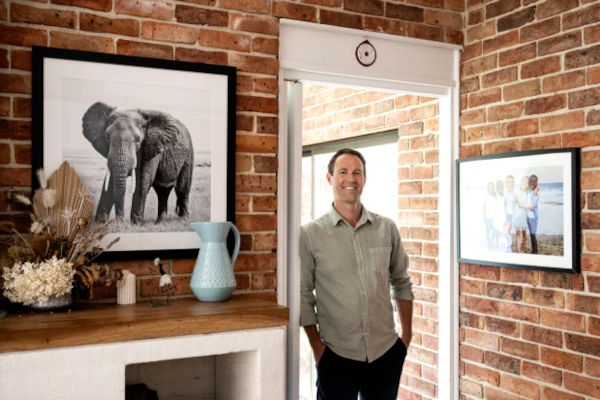
Tech heavyweights back ‘tenacious’ unlikely social entrepreneur

LONDON: A clever innovation is set to revolutionise life prospects for generations of disadvantaged and marginalised.
Mark Dombkins, a maths teacher from Wollongong, is not your typical philanthropist, nor is he your typical member of the start-up community.
The father of six never imagined his not-for-profit, Forever Projects, becoming one of the charities of choice for the Australian tech community.
But an introduction in late 2019 to Ian Gardiner from Jelix Ventures, an early-stage venture capital firm, was the catalyst for Forever Projects raising more than $2 million from some of the biggest names in the sector. The charity helps Tanzanian women learn skills to start businesses, enabling them to earn enough money to take care of their families.
Dombkins’ journey to creating Forever Projects began in 2010, when he decided to move with his wife and two young children, then four and one, to Tanzania.
“We always felt strongly about opening up our home to kids [who were less fortunate] and living and working abroad and Tanzania was a place that worked – we could work there and also pursue fostering and adoption,” he said.
“We went from two to five kids overnight [fostering and then adopting three young siblings, including one-year-old twins and a slightly older brother who was also not yet two]. We went through their social welfare system, it was a three-year process.”
It was chaos, Dombkins recalls, explaining how he would push a double pram with the twins up the top, two kids underneath sitting in the basket, and his oldest child on his shoulders, down the streets of Moshi.
“As adopting parents, you think, what would need to have changed in our kids’ biological mum’s story so that this could have been avoided? That question reconnected us with the organisation we adopted through, and they were already testing a solution to that.”
The adoption agency, Forever Angels, had been trialling a 12-month project helping new mums or their relatives in crisis. They provided nutrition for the child and a pathway for income creation for the woman through a weekly face-to-face skills training program.
They wanted to do a formal study to assess the outcomes of the program, but needed funding, so Dombkins tapped his friends and family in Australia, raising $16,000.
He returned to Australia in 2013 and formed Forever Projects in 2015 to help fund the work of the Tanzanian agency.
A core group of backers pay for the not-for-profit’s operating costs, and all other donations go directly to supporting the program in Tanzania. Dombkins also created a dashboard for donors to see how their money was being spent and the outcomes it was generating.
It is this focus on trust and transparency that has endeared him to the tech community.
”There’s so much talk about customers, friction and traction … so we’re looking not just at the problem of poverty, but at the problem of philanthropy,” he says.
“I believe people want to do good, but there are all these obstacles in their way.”
Australian Taxation Office data reveals only 53 per cent of people earning more than $1 million annually donate to charity and receive a tax deduction, compared with 90 per cent in the United States.
Gardiner, who was introduced to Dombkins via a mutual acquaintance at Macquarie Bank, says philanthropy still isn’t “part of the DNA” of Australians as it is in the US.
“The US at that upper echelon of the wealth curve is much more giving. We are not good at it here, and it’s a conversation that needs to be had,” he says.
Airtree Ventures partner Craig Blair donates to Forever Projects via his family foundation as well as through the VC fund. He says the tech sector can play a big part in boosting charitable giving.
“[Dombkins] is an unlikely social entrepreneur – scratching an itch he’s lived and breathed through his experience in Tanzania, he’s tenacious … and he’s evangelising a vision for his team.
“There’s room to give more, and the tech sector has an opportunity to lead in this area.”
-

- Forever Projects founder Mark Dombkins