Work starts to restore long-vacant Plaza for senior housing use
LONDON: The Roxbury Group, Ethos Development Partners and Lighthouse on Tuesday marked with a groundbreaking ceremony the start of construction on the historic 15-story building on West Grand Boulevard.
“The core of what made this project a reality was an incredible partnership between the City of Detroit and the State of Michigan, who together understood our common motto of the Roxbury group, namely, that nothing worthwhile is easy,” David Di Rita, principal of the Roxbury Group, said Tuesday.
The ceremony followed years of the development team assembling financing to bring the project to life.
Originally opened in 1927 as a luxury residential hotel developed by Ralph T. Lee, Lee Plaza will be transformed with 117 affordable housing units for seniors earning at or below 50% of the area median income. Residents will pay no more than 30% of their income in rent, with affordability guaranteed for at least 45 years. A second phase is planned to add up to 65 residential units on the building’s top five floors. Di Rita said those units will be market rate.
Di Rita said he expects the first phase to be completed by fall 2026, with the second phase to follow. Introduced in 2022 with a budget of $59 million, the project is still expected to stay close to that original estimate, he added. The development team is seeking financing for phase two.
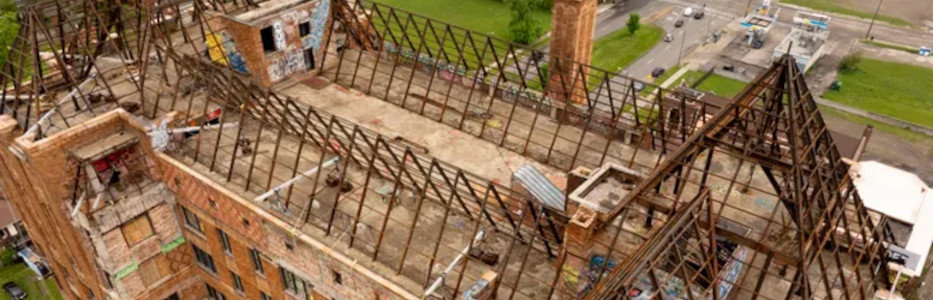
Detroit Mayor Mike Duggan celebrated the start of the long-awaited redevelopment. He noted that it was once a premier luxury hotel that had fallen into disrepair after being transferred to the Detroit Housing Commission in 1969, which used the structure until 1997.
“For 30 years, everybody coming in and out (Interstate) 96 saw this building in the skyline with the roof that you can see is not there,” he said. “And the easy thing was, knock it down and hope they forget it. But we said, ‘What would happen if you renovated it? You made that a part of the permanent sky? And what would it mean to families who need affordable housing?”
In early 2022, developers shared their plans of redeveloping the long-vacant Lee Plaza and its historic spaces, including a once-grand ballroom with gaping holes in the ceiling, a graffiti-covered dining hall and a wood-paneled smoking room missing its fireplace. On Tuesday, they once again opened the building’s doors, offering a look at the current condition of the first and 13th floors, both still in need of significant restoration.
“We have a common floor plate,” Di Rita said, standing in a wide open space on the 13th floor. “It’s a mix of one and two bedrooms, mostly one bedrooms, because that’s what the market is mostly interested in. And it really does follow the original configuration for the most part, though. The units here in the 1920s were little more cut up. These would be more open floor plan to kind of conform with modern tastes, but it’ll feel very historic.”
Due to years of neglect and vandalism, many of the historic components of the building were lost. The developers will replicate what they can, Di Rita said.
The development is supported by a complex financing package that brings together a range of public and private funding sources including low-income housing tax credit equity from both the 4% and 9% programs administered by the Michigan State Housing Development Authority, grant support from the housing authority and the Michigan Legislature.
The City of Detroit contributed funds through its allocation of American Rescue Plan Act dollars, along with federal funding from the HOME Investment Partnerships Program and the Community Development Block Grant program. Additional financial backing comes from construction and permanent financing provided by KeyBank, Invest Detroit and the Detroit Economic Growth Corporation.
JPMorgan Chase and the Royal Bank of Canada provided investments through both historic preservation and low-income housing tax credit programs. The project will also benefit from rental subsidies from the U.S. Department of Housing and Urban Development.


