Portakabin villages plan to solve emergency housing crisis
LONDON: One of the first ever PK16s, Portakabin’s earliest model, is proudly on display at the company’s headquarters just outside York — and it isn’t exactly a des res.
The simple 16ft timber box with steel legs was developed in 1961 by Donald Shepherd, the company’s founder, as a transportable hut to be used by builders. It isn’t much to look at.
Since then the company has spread its wings, branching out from builders’ portable buildings (in the 1960s) and amateur football changing rooms (from the 1970s) to create and rent out increasingly sophisticated prefabricated replacements for the UK’s crumbling state infrastructure.
A changing room from 1970 with four men, three in red jerseys, and one drying himself with a blue towel.
This includes building entire wings to prop up decaying NHS hospitals, including A&E departments (there’s even a bespoke section advertising “A&E solutions to suit all budgets and timeframes” to prospective clients on its website), and fashioning replacement school buildings. It has also done rather well out of national emergencies, having constructed temporary Covid vaccination centres galore in 2021 and a flurry of emergency classrooms after the collapsing concrete (or Raac) scandal in summer 2023.
This line of business looks secure for years to come, with the cost of rebuilding Britain’s crumbling public realm now at £49 billion, according to the National Audit Office.
Given the scale of our housing crisis it’s rather surprising that this leading prefab company hasn’t yet built a single house.
That is, until now.
The Times can reveal that Portakabin are likely to conclude landmark deals in the coming weeks to build bespoke temporary flats and houses for councils struggling with high levels of homelessness. The agreements are with 11 councils, including several in London, plus eight housing associations and “a number” of charities. The councils will rent the buildings out and place them on vacant brownfield land that they own.
The crisis councils face is acute. Many are splurging huge amounts of their stretched budgets on emergency hotel rooms many miles away just to keep their growing homeless population off the streets — a problem worsened by a sell-off by local landlords, who used to provide solutions to the problem. Increasingly desperate for accommodation, it seems temporary Portakabin homes are the answer for councils.
“The numbers [of emergency homeless people] just keep climbing and it’s alarming because it puts a huge pressure on local councils,” says the Portakabin chief executive Dan Ibbetson.
“What councils are doing is literally using [the travel website] Booking.com and booking people into hotels, low-quality hotels or hostels or bed and breakfasts, but often where a family of four are sleeping in one room and they’re staying there for six weeks and then they get moved on.
“Our solution is very much a stepping stone but it’s a significantly cheaper option for local councils to the current bed and breakfast hostels and it’s a significantly better social solution. We estimate it will save councils at least half the £2.8 billion that’s currently being spent [on emergency accommodation in England between April 2024 and March 2025].”
Plus, controversially, Portakabin has declared itself open to doing a deal with the Home Office to provide emergency prefabs for asylum seekers — although the Home Office, mindful perhaps of potential public uproar over prefab towns for refuge-seekers, is coy on this. A source says it is “not aware of any substantive conversation taking place for modular housing with Portakabin”, although it acknowledges conversations have taken place.
You can see why the company might be shy on this subject. A total of 43,600 asylum seekers arrived on small boats in the year to June, a 39 per cent rise on the previous year, and the public backlash to any temporary “asylum prefab cities” on brownfield land could be toxic.
Meanwhile, the exact nature and location of the homeless housing deals that will be struck with local authorities will be revealed in the coming days. Discussions are ongoing with Croydon, in south London, although the authority said “no decisions have been made at this stage”. Company executives showing me around the factory also mention pinch points of homelessness in Manchester, Liverpool, Birmingham and Cardiff.
The grand Portakabin housing plan
For councils it’s quite simply a case of desperate times calling for desperate measures. According to government data covering the year to March, 326,000 people (including 169,050 children) are in temporary accommodation in England — a 12 per cent annual increase and the ninth monthly record that has been set since December 2022. Of this total 183,000 are in London, which amounts to 1 in 50 Londoners. Many are families. The data shows that authorities are housing 83,150 families with children in hostels, hotels and B&Bs. Our housing stock can’t cope with such shocking social problems.
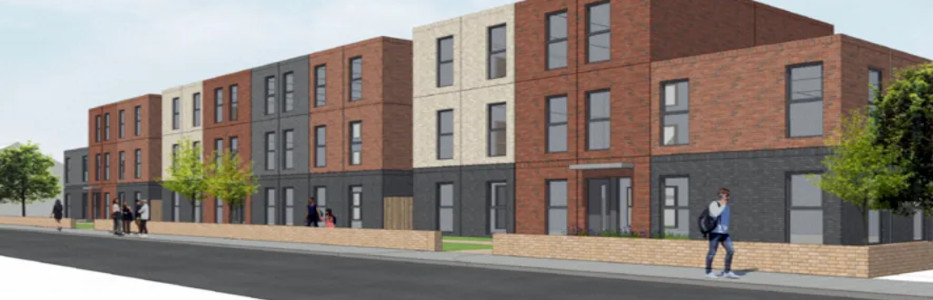
Portakabin is proposing to build prefabs clad in fake brick or wood and then rent them to local authorities at a cost starting at £14 per person a night (or more if councils request posher finishes or bigger properties). This compares with up to £90 per person per night the company claims councils are paying for a hotel room in England — and that figure is much higher in London. The company will kit the buildings out itself and there are options ranging from one to three bedrooms. Portakabin will build the units in as little as three days at its York factory and the councils involved are busy identifying surplus disused brownfield land where these buildings can go.
Ibbetson says the units will be sophisticated. “They’ll have private bathroom space. They’ll have a space to cook meals. They can stay there for a number of years while a permanent solution is being devised. That means a significant step up in life quality for those people. It has impacts on education and health.”
The prospect of doing the same with asylum seekers is also tempting and, notably, Ibbetson is encouraging this idea, although he is noncommittal about whether contact has been made with the Home Office. “They could [house asylum seekers] and we’re aware of the work that the government is doing, and the discussions that are ongoing, with the Ministry of Defence,” he says.
Simon Thomson, the company’s legal counsel, phrases his answer carefully when I try to pin him down on this. “We appreciate that the Home Office may be looking at how best to accommodate asylum seekers, and if that is the case it could be that we are in a position to support them, but that is unrelated to our transitional housing offer,” he says.
A Home Office spokesman said: “This government inherited an asylum system under exceptional strain. As part of our commitment to close all asylum hotels, we are looking at a range of more appropriate sites including disused accommodation, industrial and ex-military sites so we can reduce the impact on communities.”
A spokesman for Croydon council, where 3,562 households are in temporary accommodation, confirmed it was in talks. “Like many councils, we face real pressure due to the high demand for temporary housing and so we continue to work with partners to explore a wide range of possibilities for providing temporary or emergency accommodation. This includes possible future use of modular homes, but no decisions have been made at this stage. Our priority is to make sure everyone who needs accommodation here in Croydon is housed in a comfortable, warm and safe setting.”
What’s your mental image of a Portakabin building? So sensitive is Portakabin about its reputation that Thomson sent me an email asking me not to refer to buildings as “portacabins or Portakabins” at all. “This risks our trademark becoming genericised and is unfortunately frequently used as easy shorthand for poor quality prefabricated buildings,” he says. We must, he says, refer to them as “Portakabin buildings, Portakabin classrooms, etc”.
Its hackles were raised when Rachel Reeves, the chancellor, used her 2024 budget to lament that in Britain today there were “children in Portakabins as school roofs crumble” — insinuating, the company felt, that its buildings were of poor quality. Portakabin published a social media video immediately afterwards that featured children praising the buildings as better insulated than their normal ones.
I take a look at a two-bedroom flat made out of three cabin containers, which is displayed in York and looks a million miles from the stereotypes. The 46 sq m (495 sq ft ) property is warm and has a lovely little living area with a kitchen, a bathroom, a double bedroom and a smaller bunk bed room.
All around the site are pictures of Kensington Aldridge Academy’s Portakabin school in west London. The school’s permanent buildings had to be evacuated for safety reasons after the Grenfell Tower fire next door on June 14, 2017, which killed 72 residents. Portakabin built the entire replacement school in the summer in time for the autumn term in September 2017. It was used for a year before students were able to go back to their permanent building. Portakabin then reclaimed the buildings and repurposed them.
This temporary rental model is what Portakabin is aiming towards for housing. As well as the building itself, Portakabin is offering a package to councils that includes drafting framework planning applications, plus installing, fixing and maintaining them.
Ibbetson stresses that Portakabin’s homes are meant to be temporary. However, he also repeatedly says their lifetime is technically 60 years — and Britain is desperately short of permanent housing, with building levels plummeting, particularly in London.
Given this, why not begin to make permanent homes? “It could [be permanent housing] but we’re not intending it to be,” Ibbetson says.
In this regard the company is worried about putting all its eggs into the basket of flatpack housing — like Ilke Homes in nearby Knaresborough, for example, which was one of several prefab builders that recently collapsed as a result of thin order books and high overheads. Portakabin’s key strength is to keep its projects temporary — to recycle and reuse its containers to build something else with them, from A&E departments to sports changing rooms, whatever is in most demand at the time.
Housing experts expressed concern that the firm’s temporary prefab towns will end up becoming permanent anyway because councils will simply never to be able to replace their infrastructure. The prospect of this would be hugely controversial.
“Once you’ve established these sites with this temporary accommodation on it, even though it’s meant to be temporary it will end up being a problem to relocate that once it’s become established,” says James Pargeter, a housing expert with 25 years’ experience in residential development. “The obvious danger is that it just gets kicked down the road.”
In some ways the rise of temporary housing is a deeply sad indictment on where our society is today — but for Britain’s prefab kings our poor infrastructure will mean big business for many years to come.


