Senior housing project to combat loneliness wins unique award
LONDON: A senior housing project created to obviate loneliness has been awarded a unique award.
Britain’s best new building is more than just a senior living center. The Appleby Blue Almshouse, which won this year’s prestigious Royal Institute of British Architects Stirling Prize, brings one of the UK’s oldest forms of social housing to the modern era by incorporating designs that tackle loneliness and social isolation among older adults.
The project is a modern enlarged version of an almshouse, a kind of charity-run social housing for low-income seniors that dates back to medieval times. Traditionally almshouses are tucked away on side streets or built in the countryside, with the idea of offering residents a quiet retreat from society. But leaders behind Appleby Blue felt that can leave people feeling disconnected from their communities.
The updated concept by Witherford Watson Mann Architects begins with its placement: The Appleby Blue Almshouse is located along a busy street in the former warehouse district of Bermondsey near central London. Alongside 57 units for adults over 64 years old, architects also designed a number of social rooms that invite residents and the larger community to connect over shared meals, organized activities and chance encounters.
To be eligible to live here, residents must meet the age and financial requirement, as well as have lived in the surrounding borough of Southwark for at least three years. They also have to be open to the larger goals of United St. Saviour’s Charity, which manages and operates the complex.
“Because we wanted a place where people of all ages would come together, we made it very clear to the people wanting to live here that the community space will be there for the whole community,” says chief executive Martyn Craddock. “It won’t be a quiet residential lounge where you can just sip a cup of tea in a corner and read a book; you’ll likely hear some kids in the background somewhere.”
Compared to some past Stirling Prize recipients, which include major infrastructure projects like London’s Elizabeth Line and marvels like Zaha Hadid’s MAXXI Museum in Rome, Appleby Blue is a modest choice. But judges aren’t just looking for the next blockbuster building, says Ingrid Schroder, director of the Architectural Association School of Architecture in London, who chaired this year’s prize jury. “Within the criteria, we’re looking for something that is distinguished in its architectural expression,” she says, with an awareness for sustainability and a “public function” in the wider community.
Appleby Blue faces a well-trafficked sidewalk, where residents and pedestrians can greet one another through large bay windows that line the first two floors of the five-story building. A brick exterior, dotted with hardwood oak-framed windows, helps 5,800 square-meter complex (just under 62,500 square feet) blend seamlessly into its surrounding neighborhood of Victorian homes.
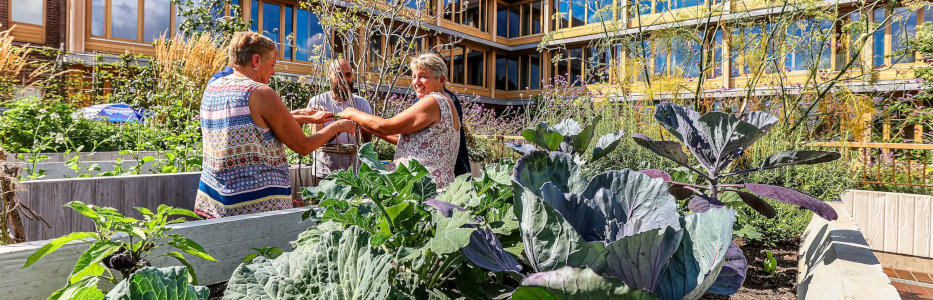
In a nod to the configuration of traditional almshouses, the north-facing building is shaped like a horseshoe, wrapped around a courtyard whose lush greenery and water features offer residents a calming place to relax. An additional two-story wing that bridges the horseshoe at the rear of the complex offers a rooftop terrace with fruit trees and garden beds for growing vegetables and herbs. This wing was also designed to be shorter so as to not block sunlight from shining into the courtyard.
Inside, flats are connected by a wide hallway featuring large windows that overlook the courtyard, and that invite natural light into the building. Schroder praised the firm’s use of passive design to take advantage of the sun to both light and warm the building.
These hallways serve as “social corridors,” with benches placed throughout offering opportunities for spontaneous interaction among neighbors. Planters and timber-clad walls, meanwhile, give the space a homey feel.
Various social rooms that encourage further interaction — including a library, hobby room and a communal kitchen and dining area — can be found on the first and second floor at the front of the complex, where the bay windows are located. These rooms aren’t just for residents; the building doubles as a community center with programming for the whole neighborhood, like cooking classes in the shared kitchen and salsa lessons for mothers and their young children. They’re also available for rent, which not only helps pay for the upkeep of the building, but also brings in people from all generations. (Residents also pay a weekly maintenance fee of around £200 a week, a fraction of rents in Southwark.)
“You can tell that people who come to use that space hang around and they want to stay,” Schroder says, reflecting on a recent visit to the site. “There’s a natural interaction between the residents and the people who are using it as a sort of community function.”
This year marks the second Stirling Prize win for Witherford Watson Mann Architects: They also won in 2013 for transforming the fire-ravaged ruins of a 12th-century castle into a contemporary home that preserves much of the structure’s original features. (“A modernist house in an ancient shell,” as the firm’s director Stephen Witherford described it at the time.)
In both 2013 and this year, judges praised Witherford Watson Mann for the firm’s radical, but thoughtful, approaches — first to historic preservation and more recently to social housing design. Whereas social housing for low-income older adults can feel institutional and isolating, Appleby Blue shows how they can offer a more dignified way of living, and how they can make residents feel connected to their community.
“It’s just an extraordinary way of also making sure that we don’t treat the elderly as a sort of alien species, as an other,” Schroder says. “They’re very visible, they’re lively, they are part of an active environment, which I think is absolutely critical and really warmed our hearts when we visited them.”
An estimated 4.3 million people in the UK over the age of 64 live alone in 2024, making up half of all Britons living solo. Often, these older adults remain in large homes that are too costly to maintain and not suitable for their physical needs, which research shows can exacerbate challenges of loneliness and social isolation.
Urban design has an important role to play in combatting loneliness. In the public sphere, this can mean building more social infrastructure — be it a library, park or community center — and designing spaces that encourage casual encounters among neighbors and strangers alike.
In private spaces, like in housing communities, architects have encouraged communal spaces like social corridors and shared amenities. Co-housing, in which neighbors share responsibilities and actively participate in community activities, has also gained some traction.
Almshouses are a small but emerging alternative to other forms of housing for older adults in the UK. They’re affordable housing, typically operated by charitable organizations, who provide programming for their residents while still encouraging independent living. In 2023, some 36,000 people lived in almshouses in the UK operated by more than 2,600 charities, according to The Almshouse Association.
Living in almshouses can give residents a “longevity boost,” according to Alison Benzimra, head of research and influence at United St Saviour’s Charity, and the author of a 2023 study with Ben Rickayzen, David Smith and Anastasia Vikhanova for the Bayes Business School at City St George’s, University of London. Data from more than a dozen almshouses going back 100 years show that residents have a higher life expectancy compared to people of similar socioeconomic backgrounds living in the wider community. A resident in his 70s could see his life extended by up to 2.4 years — a 15% increase — according to the report.
The almshouses that show the biggest life expectancy boost in their study are centered around one or two main buildings and have communal dining rooms where residents eat together, suggesting that a strong sense of community plays a significant role in combating loneliness and extending people’s life expectancy.
“What we focus on is: What is it about almshouses that contributes to not necessarily longer life, but better quality of life?” Benzimra says. “Part of it is the design: That courtyard design [at Appleby Blue] enables kind of incidental interaction; it facilitates neighborliness. And it definitely brings a community together.”


