Retirees are now living best lives in off-shore choice locations
LONDON: “It has all the excitement of Miami combined with the best bits of Costa Rica,” says Tomi Hopkins, who moved from Wiltshire to Panama in 2016 after reading an article about how the country that links Central and South America was the happiest in the world.
“It was the first week of January, I was on the tube after work, not particularly happy with my life, so I went home, packed up, and got on a plane to Panama that same evening. Three days later, while walking down Avenida Balboa, I decided to move to Panama City and have never looked back.”
Hopkins is one of tens of thousands of expats – exact estimations vary – enjoying life in the tropical climate of a country that has recently been voted the best place in the world for expats to live for the second year in a row by InterNations, the largest global network for expatriates.
At just 75,417km2, Panama is a little smaller than Ireland, with a population of around 4.5 million, and is most famous for its canal linking the Caribbean and Pacific Oceans.
The Panama Canal was under US control until 1999, so, like its neighbour Costa Rica, it is home to a number of expats from North America, but also Britain. An overwhelming majority, 94 per cent of the 10,085 respondents from 172 nationalities in InterNations’ 2025 Expat Insider survey described themselves as “very happy” with life in Panama – rating the country as friendly, welcoming and easy to settle in.
Panama’s expats enjoy good personal finances and career prospects and find admin, housing, language, and digital connectivity – so-called “expat essentials” – easy to manage. Quality of life here is, it seems, almost second-to-none.
“I adore the energy, temperature, weather, culture, food and the importance of family here – people are happy. I can’t imagine living anywhere else,” says Hopkins. The 46-year-old’s two-year-old business running classic car tours of Panama City was this year recognised in Tripadvisor’s Traveller’s Choice Best of the Best Awards.
“It feels very safe here, you can walk in the evenings, leave your phone in the car, and there is a good police presence,” he says, adding that there is real harmony in Panama. “Everyone gets along, regardless of race and religion, and it doesn’t have the boozy drinking culture that Britain has, which can spark tensions.”
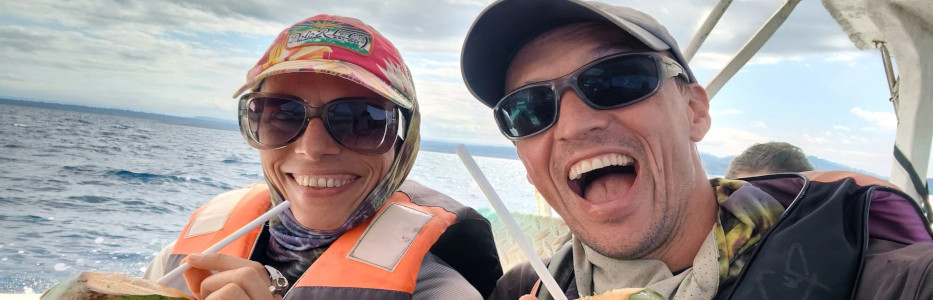
While Hopkins enjoys life in Panama’s capital, five hours away by car, on the tip of the Azuero Peninsula, live Leila and Sam Wadman, who run a fishing business in the small town of Pedasí on the Pacific coast.
“We are living our best lives here,” says Sam, 48. “I’m not going to lie, it was quite a ride starting afresh somewhere we didn’t speak the language. However, through determination, hard work and a strong vision, we are very close to living rent-free after building the self-sufficient lifestyle we’ve always dreamed of.”
Sam, a decorator, and Leila, a teacher, were living in a shared house in Brighton, when they first visited Panama on their honeymoon in 2013. They loved it so much they returned to stay at a fishing lodge where Sam was eventually offered work. After becoming jobless during Covid, he bought a boat and set up Fish Pedasi, taking international visitors fishing between April and December.
“We jumped at the chance to move here,” he says. “Back in the UK, we were both working full time, earning a good, honest living, but it was tough – we didn’t know how we were going to break the cycle of living month-to-month.
“During the Covid-19 pandemic, we bought a 1,850sqm plot in Pedasi where Leila grows all sorts of fruits and vegetables that thrive here – passion fruit, mango, avocado, pineapples, papaya, plantain – and we’re building a house out of shipping containers.”
Sam continues: “This would have been completely unattainable in the UK because of the high cost of living. I’ve managed to make my passion my work – I feel like the cat that got the cream!”
While Panama City has a diverse and vibrant food, music, festival and art culture, life for Leyla and Sam in Pedasi is much more relaxed – which Sam warns is not to everyone’s tastes. There are no cinemas, golf courses or bowling alleys for retirees – just a couple of low-key restaurants slash cafes, and bars.
The cost of living in Panama is significantly lower than in the UK, by how much depends on the region, and both Sam and Tomi Hopkins agree that, while health insurance is a necessity, doctors and dentists in the capital city are as good as any in the UK.
However, getting a visa to live in Panama has become significantly harder since Covid, as the country aims to attract retirees and digital nomads with regular income from outside the country.
To anyone looking to follow in his footsteps and start a new life in Panama, Hopkins has this advice: “You really need a good level of wealth to make the most of the country. To truly enjoy Panama to its full potential, you need the stability of regular money coming in.”


