Parents invest in multi-generational house a Gen Z kids won’t move
LONDON: Living under the same roof as your parents into adulthood has never been the goal for most, but it could hold the key for young people keen to live out their youth without the financial stress of keeping a roof over their head.
Confronted with worry over where their adult kids would go when they bought a house together, Renee Tyler, 37, and Miguel Alvarenga, 44, were forced to think outside the box.
The public transport workers, who have four kids between them, decided on an unconventional solution — a five-bedroom, five-bathroom, three-storey, intergenerational house.
“We got so stressed when we were looking and it got to a point where we were like, we’re just going to have to get a three-bedroom house, because everything’s a million dollars, whether it’s good or bad, small or big, it’s all a million dollars,” Ms Tyler said.
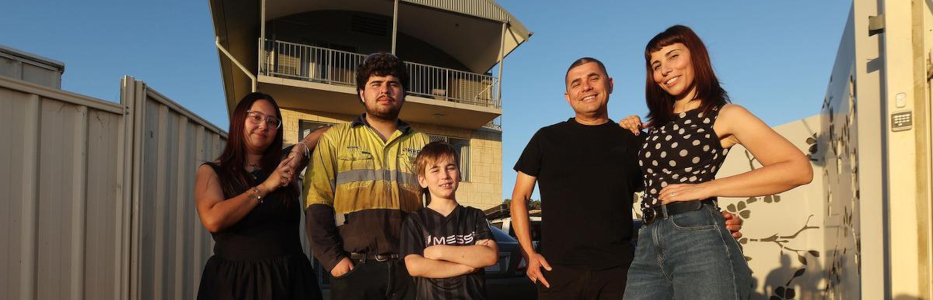
After a six-month search and more than 20 rejected offers, the couple bought a unique 2011 build in Spearwood that easily accommodates them and three of their kids, Sara 24, Michael 21, and Cale, eight.
Households with multiple generations are on the rise across WA, according to Real Estate Institute of Western Australia president Suzanne Brown, with exacerbating economic factors expected to continue increasing the trend and popularity into the future.
“We’ve definitely seen household sizes increase, mainly due to affordability. We’ve seen a lot of different generations of families living together to help combat the cost of rising sale and rent prices,” Ms Brown said.
While younger generations are struggling to afford to move out, older generations are facing their own issues of affordability or availability of beds in the aged care space, she added.
“I’ve heard a lot of cases where people are living with family while they try and find their next home. It’s not meant to be long term, but obviously, with only 2000 properties on the market for sale, supply is so constrained, it’s a real factor for a lot of people,” Ms Brown said.
For the Tyler-Alvarenga family, settling on the intergenerational house was a no-brainer.
The couple bought it last June for $950,000 and it has plenty of space for any future partners and even kids of their children, who will all be welcome to stay for as long as they need.
“You want your kids to move out, but it’s probably just not going to happen,” Ms Tyler said.
“Where are our kids actually going to go? They can’t rent anywhere because of the rental crisis and the likelihood of them being able to enter the market is pretty minimal too.
“So the idea was, if we needed to have them and their husbands and wives and their children living in our house then we could, because we have a house big enough to cater for it.”
While intergenerational homes can be done on smaller Perth blocks like the 390sqm that hosts the Spearwood house, such developments would be more practical in outer suburbs where block sizes between 400sqm and 500sqm are more common, Ms Brown said.
Ms Tyler said had they left the decision to buy an intergenerational house any later, the situation could have been very different.
“If in five years’ time we needed to make that decision, with how things are going with prices, we probably wouldn’t be able to provide that help for them,” she said.
According to home loans expert Richard Whitten, intergenerational housing is a trend that will continue to grow.
“Much of this is a result of worsening housing affordability. It is now common for adult children in Australia to move back in with their parents to save money,” Mr Whitten, from comparison website Finder, said.
”It’s a response not only to the housing crisis but also the cost of aged care and childcare. Multiple generations living in one house is a way to ease both those costs while bringing families together.”
A Finder survey of more than 1000 people revealed 13 per cent of Australians had either moved back home to live with parents or had an adult child return home in the past five years.
Stress about affording a house had been alleviated for Ms Tyler and Mr Alvarenga’s older kids, who before moving into their new blended household home, had already started feeling “left behind”.
“For myself and Miguel, two professionally successful people in our 40s and 30s, it was such a challenge to buy a house,” Ms Tyler said.
“What competition are they going to have at their ages and in their price bracket?”
Ms Tyler said without help, their kids — like many their age — would have no choice but to put their “Australian dream” on hold, perhaps forever.
“Should they have to delay those plans by 20 years and have kids in their mid 40s because they can’t go and do the Australian dream thing of buying a house, getting married and having kids because they can’t afford to do it?” she said.
“So my worry was that they were going to have to actually sacrifice that part of their life because they didn’t have a living arrangement that could support doing that.”
With Perth’s median house price jumping to more than $1 million in the December quarter and forecasters predicting further growth of more than 12 per cent in 2026, it’s no surprise young people feel trapped.
Skyrocketing house prices have been blamed on low listings, lack of land supply and low build completions, plus the Federal Government’s First Homebuyers Scheme.
While the Tyler-Alvarengas hope their kids will be in a position to buy their own house and move out at some stage, they know that if they can’t, they can stay with them “forever”.
“I didn’t want to wait and find out in five years time when we also can’t afford to go and get something,” she said.
In the meantime, the older kids can go back to enjoying being in their 20s.
“They can go and travel and not worry about these things,” Ms Tyler said, acknowledging how easy it was in comparison for her to buy a house when she was 21.
She added while it might seem overkill for the older kids to have entire living quarters to themselves now, they expected it would prove more crucial as they aged.
“I always make the joke, ‘if you guys want to live here with your husbands and wives and your kids, it’s cool because you can have a level each’.
“That’s how the house was actually built. It was designed for three families to live in.”
The home feels more expansive than its 350sqm building size, which Ms Tyler said was a credit to the original build, which took about five years.
In a sweet twist, the blended family had grown even closer since moving into the home.
“I’m so lucky because the big kids, as we call them, are so good and so helpful, and they all just love each other. It just couldn’t have gone any better,” Ms Tyler said.


