Historic houseboat community attracting downsizers to life afloat
LONDON: As evening falls, Jess Aidley enjoys watching the lights twinkling in the apartment blocks transforming the waterfront in Shoreham-by-Sea from her houseboat, a 19th century Thames lighter barge named Myrtle.
Over the next five years, hundreds of new homes will be built on reclaimed industrial land around the West Sussex harbour.
Across the River Adur and further inland from the harbour, some 40 or so houseboats got here first.
The earliest houseboat residents came to Riverbank, a stretch of land tucked away on the opposite bank of the Adur from Shoreham town centre, because inexpensive brick and mortar homes were in short supply.
They were artists, writers and people working in the nascent film industry. Shoreham was a birthplace of British silent movies in the early 20th century, with several studios setting up there because of the quality of the natural coastal light.
Now, although there’s still a lively creative community, the appeal of houseboat living is attracting professionals, as well as retirees and downsizers. This means prices for houseboats have shot up in recent years and the face of the community is gradually evolving.
Around six or seven of these Riverbank vessels are some of the few remaining “Spitfires of the Sea” – decommissioned Royal Navy motor torpedo boats, motor gun boats, and motor launches from the Second World War.
Other ex-military craft include “Fische”, a German minesweeper from the Cold War.
“These boats were designed with a relatively short life expectancy, as you can imagine,” explains Mike Green, who lives on Rebus Stone, a Humber barge built in 1963, with his wife, Lisa.
“Most have been so modified and added to over the years they’re not recognisable as sea boats now, but they are habitable.”
At 83, Aidley is one of the oldest residents. She moved here in 2010 from Wales to be closer to her daughter, who now lives on the next-door houseboat.
“I ended up here because I needed a home, it was either that or go and live in a two-bedroom bungalow,” she says. “Boats were much cheaper than houses then. I paid £172,000, but they have gone up enormously since.”
Boat-dwellers came to this spit of salt marsh and mud flats between the estuary and the English Channel in the 1920s. By the 1930s, there was even a floating nightclub, The Showboat, on a paddle steamer.
By the 1960s and 1970s, yachts, ferries and fishing boats helped form an eclectic flotilla colonised by those seeking an alternative lifestyle.
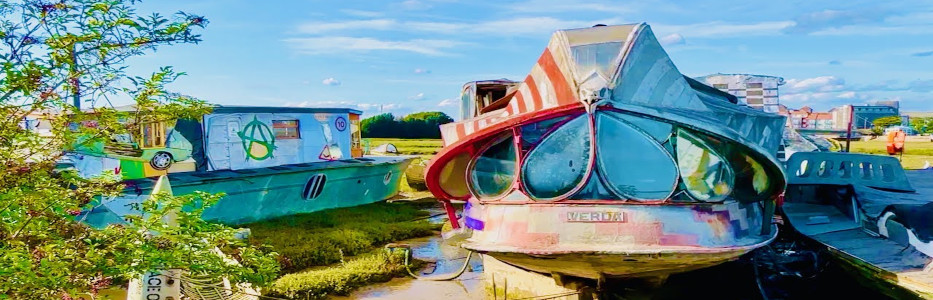
Some are mad assemblages of old cars, coaches, driftwood sculptures, and even a fantastical metal fish head.
Among it all is a Grand Designs floating home, seen on the Channel Four series in 2025. It’s built on a plot formerly occupied by a landing craft deployed in the Normandy landings that was rotting and had to be dismantled; presenter Kevin McCloud called it “Darth Vader’s boat house”.
“When the bow was finally removed to make space for the new boat build, the owners invited fellow Riverbankers to join a toast to the old boat as she was finally craned out of the water,” recalls Green. “It was a very nice way to mark it.”
The plot cost the owners, an architect and interior designer, £255,000. Their home, a three-storey steel-clad structure, took three years to build at a cost of £465,000.
Shoreham houseboats do come on the open market through estate agents, or news of a potential sale passes by word of mouth.
Buyers own the freehold of the land on which the boat sits, from the path along Riverbank down across the mudflats to the water’s edge at low tide.
Freehold ownership gives houseboat owners ‘riparian rights’, which allow fishing, sailing and swimming. Residents also have responsibilities to protect wildlife and to keep the shore rubbish-free.
Shoreham is also home to one of the UK’s smallest RSPB reserves, where oystercatchers and little egrets hunt worms and shellfish in the mud.
The houseboats are classed as “chattels” rather than property. Just like “normal” houses, they have water and electricity, plus LPG heating and some have log burners.
Most fall into council tax Band A. They are mortgageable, but interest rates are higher than standard mortgages; while the freehold retains its value, the boat itself is seen as a depreciating asset.
People do live here and commute to “normal jobs”, says Green, previously vice-president of a major orthopaedic company, and now a RNLI (Royal National Lifeboat Institution) crew member.
“You see people in the morning going to work, crossing the footbridge into Shoreham to the train station,” he says.
“I’ve always wanted to live on a houseboat. I grew up near Portsmouth and boat-fished and sailed from an early age. Coming here enabled me to join the RNLI as that is really important to me, being able to give something back as a volunteer.”
The Greens, who are in their fifties and have three children in their twenties, moved to Riverbank in 2022 after selling their family home in Hove.
Their boat, Rebus Stone, was used to transport oil and fuel in the Humber estuary and around Portland and Portsmouth, and moved to Shoreham in 2007. The couple also rent out a separate one bedroom hideaway on Airbnb.
Lisa Green is an artist (rebus.stonearts on Instagram), her work inspired by the surrounding nature. She also holds workshops in her studio, a 20ft high timber-beamed space which floats at high tide.
Aidley, a non-stipendiary Anglican priest with a PhD in zoology, enjoys spending her days painting in her studio too, and writing poetry. “It’s very much a caring community,” she says.
When Myrtle’s iron hull started to let in water, locals arrived in their kayaks, pulling together to fit a rubber “nappy” around the boat.
Kayaks are handy transport around the river. Over on the Adur’s north bank, Ocean Reid’s nine-year-old daughter, Indie and son, River, six, like to go to school in their kayaks, often accompanied by the local seal.
Ocean, 52, and his wife Natalie, 46, arrived from Brighton in 2013. Ocean is a musician and shadow writer (composing songs for other artists) and Natalie is a home and lifestyle assistant. “I could just imagine myself sitting on the deck writing songs,” Reid says.
The couple built Venezia, their floating house, for around £80,000, complete with LPG central heating, hot water, a gas oven and double-glazed windows. She is well-insulated so fuel bills stay low, at just £35 per month in summer and £70 per month in winter.
The rental moorings are billed by the dimensions of the vessel, which are around £3,000 per year. In comparison, rent for a three-bedroom house in Shoreham-by-Sea is around £21,000 to £30,000 annually, says Reid.
Both children were born on board. “The midwives had a great time as they’d never done any home births on a boat before,” says Reid.
The family also have a catamaran and spend summers sailing to France and around the south coast, chronicling their adventures on their Instagram account, Into The Blue Crew.
Aidley’s neighbour, Lynda Nurse, 52, also moved here from Brighton. The environment helped inspire Nurse, a former creative director, to set up a business, EcoOctopus, selling recycled textiles and jewellery she makes from sea glass and treasures found around the shore.
“Living on a boat comes with its fair share of problems,” she admits. Her home, Guidance, a wooden Humber barge, launched in 1904 and used for carrying coal, has almost sunk twice because the hull eroded.
“Our boat is pretty old and constant maintenance is required. It is only still here thanks to support from the community.”
Nurse and her partner used a marine mortgage to purchase their boat and the land it sits on for £200,000. Marine mortgages work much like home mortgages, and usually require a substantial deposit of between 20pc and 30pc of the boat’s value.
Boat life is not for the faint hearted: “Every storm hits hard so we must be prepared to dig in, whatever the weather.”
As Shoreham transforms around them, digging in is exactly what Nurse and her neighbours are doing, despite the nosy tourists who poke their cameras through portholes.
“But when the tide goes out, it’s so quiet you can even hear the worms going in and out of the mud, like the gentle popping of champagne corks,” says Aidley. “It’s wonderful.”


