Best social housing community design for Global Awards shortlisted
LONDON: The shortlist for the best social housing community design has been declared.
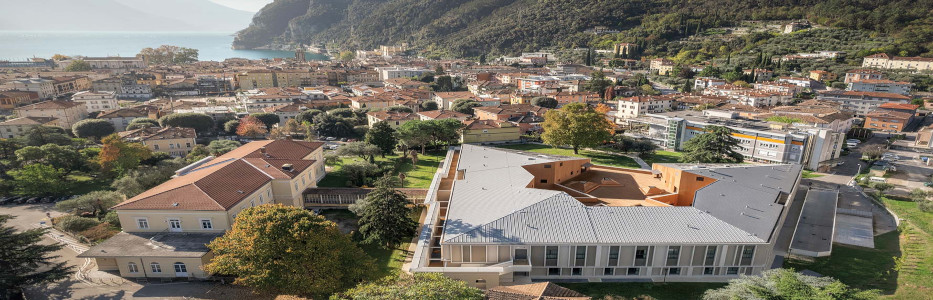
Over 250 designs have been considered by the awards secretariat. One of the finalists in this category is shown above.
Lago Di Garda is much quieter and less star-studded than the better-known Italian lakes of Como and Maggiore. And reaching Riva, as the locals call it—the town at Garda’s northernmost tip—requires some real grit and gall from the driver’s seat. The winding cliffside road leading there, which darts in and out of tunnels, some single-laned, is certainly not for the faint-hearted. But the destination’s crystal-clear water, warm if breezy microclimate, and Alpine backdrop make the journey well worthwhile. Adding to its mystique: the 17,000-person town in the province of Trentino feels suspended between cultures. The area had previously been a part of Austria-Hungary, until 1919, when it was annexed by Italy. Walking through the streets, one can hear German seemingly as often as Italian.
This idyllic setting made Riva del Garda a prime location, at the turn of the 20th century, for the construction of a large public hospital that promised patients a secluded and carefree recovery. Inaugurated in 1902, and situated on a hill overlooking the city, the Ospedale-Ricovero served that purpose until, ultimately, the same relative remoteness, exacerbated by changes in approach to patient care, pushed the institution into a state of disuse. In 2009, a partnership formed between Euro Project Engineering Consulting and the Milan-based Cino Zucchi Architetti (CZA) beat David Chipperfield Architects and others in an international competition to reenvision the hospital campus as an assisted-living facility, “in such a way that the structures truly become residences, places of life, therefore pleasant and serene,” as the brief put it.
The former hospital comprised four parallel linear buildings, each dedicated to a different medical field and connected by a long, glazed corridor that bisected them. CZA’s scheme proposed razing two of the dilapidated structures and using the remnants of a third as the spring point for new construction. (The fourth building, still extant, now serves as a high school.) In realized form, the assisted-living facility—called the Welcoming Citadel—features a polygonal plan that is reminiscent of a medieval fortress’s, with its sole point of inflection marking the entrance, and a multilevel, starburst-shaped courtyard at its core. “There is a bit of a Colin Rowe Collage City attitude, or even of Camillo Sitte,” says principal Cino Zucchi. “It borrows from this idea that, in the old cities, open spaces were carved out of a solid mass.”
The Global Award winner will be announced in December in London. (Globals)


