First passive-designed social housing block revealed
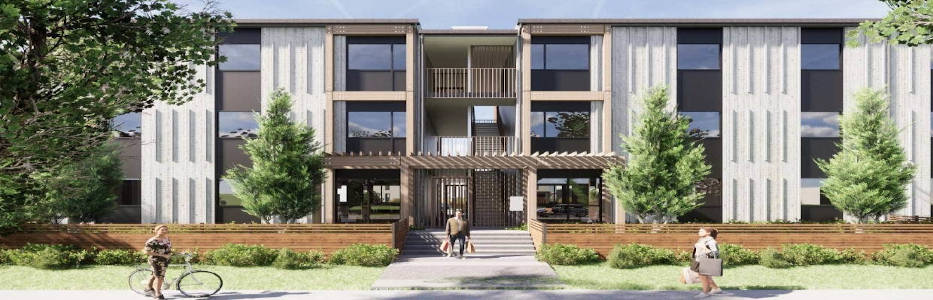
AUCKLAND: The design for the first passive social housing apartment complex has finally been revealed.
Kāinga Ora is about to walk the talk for healthy homes and sustainability – social housing tenants are likely to pay just $1 a day to heat their homes in a new social housing block planned for completion in 2023.
The crown agency has taken its first step towards a certified passive public housing development, with a pilot project now under construction in Māngere, Auckland – a development that will deliver a reduced operational carbon footprint and ultra-low power bills.
The three-storey, 18-home Bader Ventura development, on the corner of Bader Drive and Ventura Street, has received design endorsement to build to Passive House standard, which is the first major milestone to producing a certified Passive House.
Kāinga Ora general manager construction and innovation Patrick Dougherty, says the development will be a win for both the environment and the homes’ new occupants.
“For Kāinga Ora customers, it will mean a reduction of around 85 per cent in heating costs and a year-round healthy home.
“This means we expect the average annual heating energy bill in these homes to be around $360, or $1 a day, compared with about $2000 for a standard Kāinga Ora home built to 6 Homestar standard, and even more for an older home.”
The building will comprise six 83-square-metre two-bedroom and 12 119-square-metre three-bedroom homes in a three-level walk-up typology.
Homes will be airtight and regulate their own temperature through smart design, the use of high performing construction materials, and a ventilation system with heat recovery that not only maintains a steady temperature but also reduces moisture, creating a dry, healthy living environment.
Other special features reduced thermal bridging with thermally broken door and window joinery, which help maintain a constant air temperature of 20 deg C all year round.
Dougherty says the building will be targeting an 8 Homestar Version 4.1 rating and will deliver an accepted alternative to the Healthy Homes Standard for heating.
The 18 units are the final stage of a large development, which, when completed, will provide 34 homes on a site formerly occupied by 12 old state houses, many of which have been moved to the regions. The first units on the site have already been built to a 6 Homestar rating.
While Dougherty would not comment on cost per unit of the passive-design housing due to commercial sensitivities, he says the above-ground cost of the development will be in the vicinity of $3500 to $4500 per square metre plus GST.
“There is a premium attached because we haven’t done it before, but it’s not an outrageous cost compared to what we are achieving.”
He anticipates there will be economies of scale in the future, when numbers increase. At present, there are seven other passive-design buildings in the design phase – all are three-level walk-ups in Auckland.
While the current build will be low-carbon fly ash concrete, other materials will be investigated for future projects – the organisation already uses CLT (cross-laminated timber) in other projects.
Dougherty says the project will be Australasia’s first Passive House public housing funded by central government. Bader Ventura is also the first project in the organisation’s Carbon Neutral Housing Programme. And it is a big step towards meeting MBIE’s Building for Climate Change 2035 proposed final thermal performance cap 12 years ahead of industry expectation.
Chelydra Percy, BRANZ CEO says the desire to take meaningful climate and environmental action is evident within the construction sector.
“We have a history of being resourceful, clever and thoughtful to solve problems, generate new ideas and take action. We have the opportunity to take our action to the next level by collaborating to find solutions across the system.
“Kāinga Ora is setting a high standard for others within the building and construction sector. The Bader Ventura development demonstrates that low operational carbon buildings can, and are being delivered, within New Zealand. The project is an open challenge to our industry, that we all must step up and address our climate change emission reduction obligations now.”
Kāinga Ora currently has 3500 homes under construction or refurbishment. In the year ending June 2021, the organisation delivered 2400 new homes.
The Passive House Standard originated in Germany. It is recognised internationally as a best practice benchmark for low energy use, indoor environmental quality and health performance, especially when applied to social housing.
New Zealand currently has approximately 60 certified Passive Houses and more on the way. The Passive House Institute NZ, Te Tōpūtanga o te Whare Korou ki Aotearoa has a list of certified Passive Houses on its website.
Key project partners in the project:
- Build partner: Precision Construction
- Architect: Peddlethorp
- Structural engineer: Kirk Roberts
- Passive House lead and facade engineers: Oculus
- Building services engineers: 2PiR Consulting
- Passive House certifiers – Sustainable Engineering


