I have MND and I’m putting millions into finding a cure
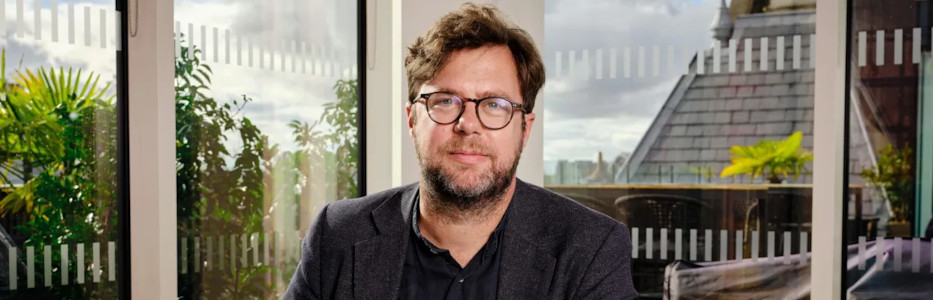
LONDON: Three years ago, when Tris Dyson was first diagnosed with amyotrophic lateral sclerosis (ALS), better known as motor neurone disease, he naturally asked what his treatment would be. He was told that there was no treatment. So he asked what his prognosis was. He was told that he could expect to live for three to five years. Motor neurone disease is sometimes called the “1,000 day disease” – but this is basically a guess, based on average lifespans.
Even the method by which he had been diagnosed seemed almost surreally inexact. Dyson, who runs Challenge Works, an arm of the innovation foundation Nesta, had just become a father for the first time and, with one thing and another, it had taken him a while to go and see his GP about a stiff thumb. What began as a minor irritation set off a chain of inconclusive tests until the doctors ran out of things to rule out. “Eventually they watch you twitch, they hit you with a lollipop stick and see how you react… and then they say you have ALS.” Even as it dawned on him and his partner Jenny that he had just been diagnosed with one of the most terrifying diseases there is, his overriding sense was how bizarre it was. “This was what you might have expected 100 years ago,” he says. “It’s not any different.”
Three years later, sitting in his office overlooking the Thames by Blackfriars Bridge, Dyson looks remarkably well. He’s wearing a pair of hip yellow trainers he picked up on a recent family trip to Japan and is talking with the enthusiasm of a man who has been given an extra chance. “Where I am now compared to my initial diagnosis is not what I expected,” he laughs. “In a good way.”
He also has a mission – which derives from an unusual confluence of life circumstances and work. For the past decade, Dyson’s day job has been designing “challenge prizes” that incentivise breakthroughs in fields from healthcare to agriculture to space technology. The idea is simple: set a problem, offer a reward and back the innovators who can solve it. While most government research and development funding ends up targeted at well-established institutions offering predictable results, this model incentivises “plucky outsiders” to think outside the box. “It’s payment on results,” he says. “You’re being rewarded for your ability to hit outcomes. When you’ve got a problem that’s a sticky problem – and the usual players aren’t coming up with the solutions – it can be really great.”
ALS, a neurodegenerative condition that causes progressive muscle wasting, incapacity and ultimately death, is one such problem. As Dyson discovered, there has been no significant advance in treatment since the British neuroscientist Russell Brain first named motor neurone disease in 1933. But Dyson hopes to change that. The Longitude Prize on ALS, launched in June, is a £7.5m global competition to find new treatment pathways by interrogating the world’s largest dataset of patient information. “We’ve pulled together around 10,000 patients’ data from all over the world,” he says. “It includes whole genome sequences, multi-omics data (a form of complex biological analysis), clinical data. It’s incredibly dense – and it’s never existed in one place before.”
The goal is to use AI to identify “targets” in the biology of ALS – molecules or processes that, if altered, could change the course of the disease. “If you can find the right targets, then you can target a drug at it,” he explains. “That’s the holy grail.”
This year, The Telegraph’s Christmas Charity Appeal is supporting the Motor Neurone Disease Association (MNDA), which campaigns for patients and funds critical research. Dyson’s prize has the potential to transform the field – and donations raised through the appeal will help ensure that patients like him, and the scientists working for them, have the resources to move faster.
One of the worst things about ALS is the lack of hope. A drug called riluzole, developed in the 1990s, may extend life by a few months, but its effects are uncertain. Drug development, meanwhile, is notoriously slow: a potential treatment must move from lab discovery, through years of animal studies and three phases of human trials, before regulators will approve it. The whole process can take more than a decade – which is scant comfort when you have been given 1,000 days to live.
However, Dyson believes that by using AI and thinking innovatively, there is real scope to collapse that timeline. “Stephen Hawking gave a lecture for Google Zeitgeist in 2015. He basically said just that: AI is scary, it could mean the end of humanity and so on. But he also said, there’s tremendous opportunity, particularly in our understanding of complex diseases. It could be transformational.”
If optimism is his professional language, realism is his private one. He’s still able to work, type (with difficulty) and pick up his pint glass. “I use two hands for that,” he laughs. “But if you met me in the street, you wouldn’t know.”
At home, life revolves around his partner Jenny, who works in international development, their daughter Indira, and a “crazy spaniel” called Monty. When he was diagnosed, Indira was barely one. “I didn’t think I’d see her go to school,” he says. “But now I’m visiting primary schools, trying to work out which one she should go to. She’s just such a source of energy and excitement and joy. Everything’s an adventure.”
Still, while things are vastly better than he feared they would be at this stage, it is impossible ever to forget the diagnosis entirely. “Part of you doesn’t believe it all the time… Sometimes you can dream it’s not happening,” he says. It is the latter stages of the disease that scare him most. “Losing my voice. You’re supposed to record your voice and then you can use these amazing AI machines to recreate it synthetically. Apparently it will sound very similar. But I haven’t got round to doing that yet. I keep putting it off because it’s one of the scariest things.”
It’s the lack of self-agency he finds most terrifying. “The idea of being locked in with all my mental faculties. There’s no way around it, that’s not a happy thing to think about. And then I wonder how long I’ll be in that state for.”


