Long-term outlook remains strong despite current weakness

LONDON: The long term outlook for the residential care sector remains strong despite its current weakness.
In the last article on the REIT from late October 2020, I proclaimed that “Winter Is Coming, But So Is Spring.” In other words, darker days are ahead, but the situation would improve with the coming of Spring.
Well, Spring came and went, but unfortunately NHI didn’t enjoy a meaningful rebound in its tenants’ operational performance. Instead, the situation got worse and worse into the Spring months.
Apparently, management has now decided to cluster all the possible bad news into 2021. At the end of Q1, management discussed all the steps they would take to reposition NHI back on the right path. These steps include dispositions of underperforming properties, lease restructuring, rent deferrals, and a probable dividend cut.
It’s a dour moment for NHI shareholders. Without a doubt, things look bad in the short term. But in the long term, I remain bullish on NHI’s strategy in triple-net leased senior housing, and I view the current stock price around $68 as a decent entry point for long-term buy-and-hold investors.
Let’s look at an update on the senior housing sector, the long-term demand growth ahead, and NHI’s current status.
Update On Senior Housing
If you have observed or read news stories about senior housing real estate over the last year, you know that COVID-19 was a heavy blow to the sector. It raised expenses for operators because of the need to protect residents and staff, and it significantly reduced occupancy rates as many facilities became hotbeds for viral transmission, which deterred new residents.
And then, of course, there were restrictions on community activities and visitors. The prospect of moving from a single-family home to a vibrant community where one’s family members can regularly visit is one thing; moving from a single-family home to a small, isolated apartment is entirely another.
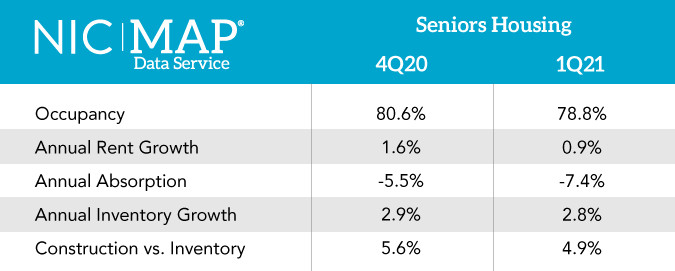
The senior housing sector is still suffering from these effects, as occupancy rates have lagged improvements in the situation as measured by vaccinations and viral case growth. Vaccinations recently reached 91% for senior housing residents and 65% for staff, and yet occupancy rates have continued to decline through the end of March. In Q1 2021, senior housing occupancy hit a record low of 78.8%, down 1.8 percentage points from Q4 2020 and 8.7 points below Q1 2020.
There is an ongoing debate about how fast occupancy will recover in this sector. Some industry experts believe that the pandemic created significant pent-up demand and that occupancy rates will spring back quickly once regulations are lifted and viral transmission subsides. Others think that prospective residents will take a “wait and see” approach to ensure the safety of retirement communities before pulling the trigger.
The good news is that there are at least some signs that senior housing occupancy is beginning to recover. As of mid-May, Senior Housing News reports that occupancy is slowly rising, but the huge pent-up demand that was widely expected has not manifested.
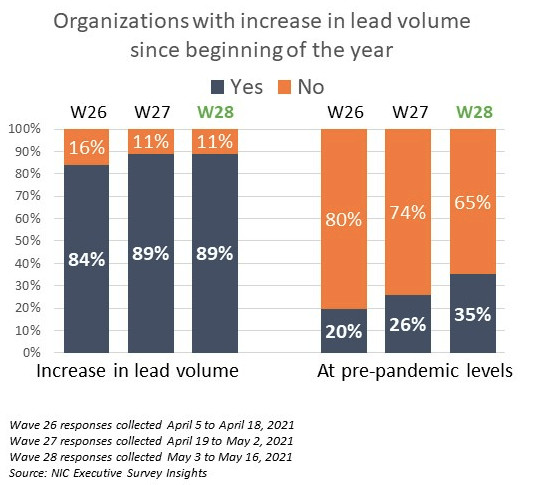
Almost 90% of senior housing operators now report leads rising month-over-month, and a little over a third of them report the pipeline of leads reaching pre-pandemic levels.
Of course, senior housing is not one monolithic bloc. There are multiple types of senior housing, ranging from less care-intensive to extremely care-intensive.
On the less intensive end, we find independent living centers that are basically apartment complexes geared toward seniors, with very little by way of healthcare services. In the middle but still less care-intensive, there’s assisted living, which involves more health and medical care but still basically has an apartment complex feel.
On the more care-intensive side, there are nursing homes (or “skilled nursing facilities”), which provide comprehensive care for seniors that require assistance even with daily living activities. Likewise, memory care facilities provide specialized care for Alzheimer’s and dementia patients.
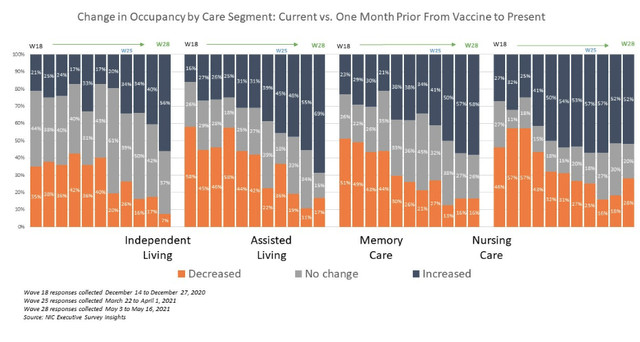
Each of these four sub-categories of senior housing have seen improving metrics in the last few months, with independent living and assisted living in particular reporting increasing occupancy.
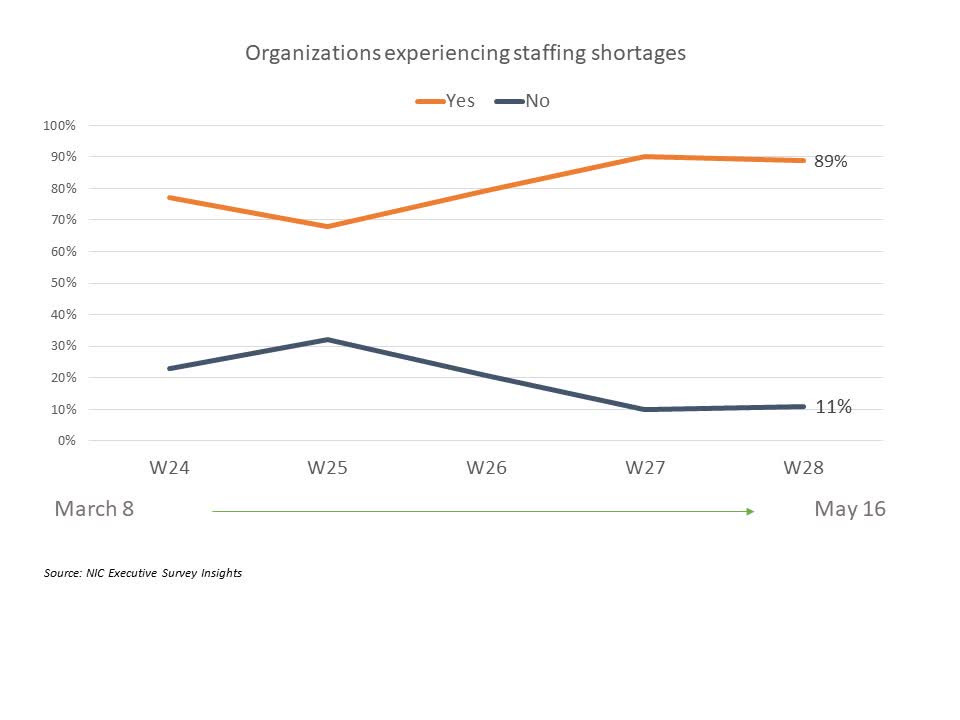
Rather than occupancy issues, one of the biggest problems facing senior housing operators right now is staffing. Like so many employers in the retail and food service spaces, it is very difficult to find workers in the senior care industry.
In order to attract workers, senior housing operators are increasing wages as well as offering referral and hiring/sign-on bonuses. This will continue to pressure operator financials, especially since rent rates dropped for all sub-categories but skilled nursing over the last year.
The good news is that the current employment situation will probably improve markedly by this Fall, as schools reopen, some states cut off enhanced unemployment benefits over the summer, and the federal government ceases enhanced unemployment benefits in September.
What’s more, as of the end of May, the United States reported the lowest daily death and case count of COVID-19 since March 2020, an encouraging sign that life is getting back to normal.
Long-Term Demand Growth And Short-Term Supply Constraints
It is commonly known that the United States (along with virtually every other developed nation on Earth) is an aging society with a large cohort of baby boomers that will steady grow the over-75 years old population.
According to the National Investor Center for Seniors Housing & Care:
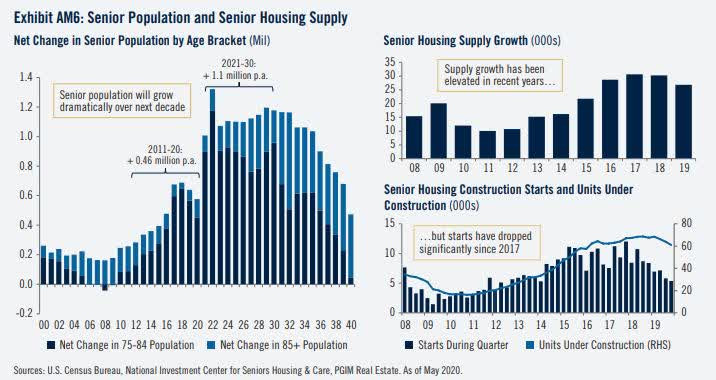
As of 2019, approximately 6.8% of the US population, or roughly 22.6 million individuals, were aged 75 years or older. By 2025 the population over 75 will grow to 28.6 million and by 2030 grow to 34.5 million.
This is the age group most likely to utilize one of the various forms of senior housing. According to Haven Senior Investments:
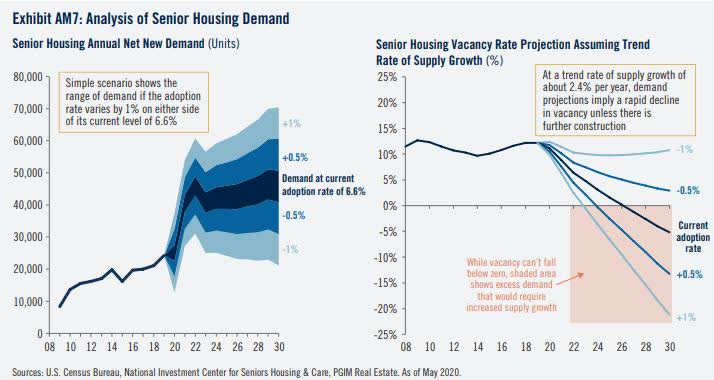
There is a strong correlation between the size of the senior population (those aged 75 years or more) and demand for senior housing units, with adoption rates consistently in the range of 6.50-6.75% over the past decade. In other words, for every additional 1,000 seniors in the population, an average of 66 additional senior housing units are occupied.
As long as that percentage remains roughly the same (around 6.6%), then demand for senior housing should accelerate in the coming years.
And yet, as you can see in the bottom right chart above, housing starts have been consistently falling since 2017, when the sector became overbuilt.
Moreover, a May 14th article in Senior Housing News reports that, though development and construction activity is beginning to pick up, new senior housing development remains at a lower level than at any time in recent years. Fortunately for landlords of existing properties, high construction costs are delaying and even canceling many projects, which should give more time for demand to catch up with the available supply of housing.
Housing units under construction declined from 7.0% of total existing supply in Q4 2019 to 4.7% in Q1 2021, according to a recent JLL Valuation Advisory report.
This should set up a dynamic in which demand has plenty of time to catch up to available supply. To quote Haven Senior Investments:
In the next 10 years, the senior population cohort will grow at more than twice the pace of the past decade – from 23 million to 34 million, an increase of nearly 50%. Assuming the rate at which seniors adopt senior housing remains constant at 6.6%, new demand will average 41,000 units per year in the next 10 years – about twice the recent five-year average of just over 20,000 units. Even if adoption rates were to fall significantly, by, say, a full percentage point to 5.6%, net new demand would still average more than 23,000 units per year.
As you can see in the chart on the right above, vacancy rates are projected to hit zero by around 2026 if current rates of supply absorption persist.
Update On National Health Investors
I begin this article on NHI with such an extended discussion of the current and future state of senior housing because it gives a big-picture view of what’s happening at NHI right now. Rather than focus only on the present, which looks very bad, it’s important to understand that the present day situation is probably an anomaly rather than an indefinite trend.
CFO John Spaid explained on the Q1 conference call in early May:
And as of today, we cannot point to the sort of robust pent-up demand we normally might see in senior housing after an infectious outbreak. So, we believe determining the extent of the recovery is still a few months away.
Indeed, the situation has continued to deteriorate since early May. In April, NHI collected 83.5% of contractual rent, and in May that rate dropped to 77.5%. That amounts to an average of 81.5% rent collection for Q2 so far.
In response to these deteriorating metrics, management has apparently decided to stack all the potential bad news into this year, perhaps taking advantage of the favorable (and forgiving) equity market backdrop.
CEO Eric Mendolsohn stated on the Q1 conference call:
Now that the impact of the pandemic is beginning to wane, we’re starting to make some of those decisions which we expect to result [in] a portfolio of stronger assets, less operator revenue concentration, and healthier EBITDARM coverage ratios. This can be accomplished by, restructuring leases, selling underperformers, and changing out operators who are not the right fit.
Management also plans to firm up its portfolio quality by selling a number of underperforming properties (largely leased to one of its larger tenants, Bickford). Over the remainder of the year, NHI plans to sell another $250 to $400 million of assets, over and above the $52 million already sold in Q1.
In addition, management plans to diversify a little bit into medical office building mezzanine loans and specialty hospitals (behavioral health facilities).
Lastly, there is one more potential (and probable) change that management is looking at: a dividend cut.
On the Q1 conference call, Mendolsohn mentioned possible “changes to our approach to our dividend.”
And CFO John Spaid stated:
Our dividend and any adjustments to our dividend in the coming quarters will depend upon our determination of what the slope of the recovery line will look like.
Finally, Mendolsohn answered an analyst’s question about the dividend by saying:
…if we’re doing dispositions to the point that we’re affecting NHI’s NOI, we keep a careful eye on our payout ratio. We don’t like to go above 85%. So, in the event that these dispositions change our NOI to the point that we’re above 85% or some other metric that the Board decides then, we would have to look at our dividend payout.
Well, Q2’s rent collection so far has come in lower than Q1’s, and yet Q1’s dividend represented 85% of FAD (funds available for distribution). Between planned dispositions and weak rent collection, a dividend cut appears imminent in order to keep the payout ratio under 85%.
We’ll find out exactly what management decides when the next dividend is declared in mid-June.
A dividend cut is very disappointing for investors (including myself), but it will probably be worth it to preserve NHI’s BBB- credit rating (from S&P and Fitch, both stable). Throughout this tragic pandemic era, NHI has managed to keep its balance sheet in good shape.
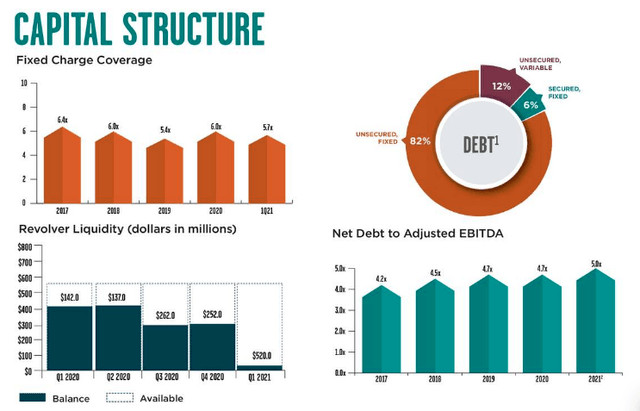
The weighted average cost of debt remains low at 3.24%. The interest coverage ratio is 5.4x, the same number as the first quarter of 2020. Fixed charge coverage sits at 5.7x, slightly above Q1 2020’s 5.6x. And almost the entire credit revolver has been paid down, leaving $520 million available in Q1 2021.
Net debt to EBITDA is higher than its recent levels at 5.0x in Q1 2021 versus 4.7x the same quarter of the prior year. However, that is largely due to a drop in EBITDA rather than debt expansion, as total debt to gross assets of 40.1% is lower than Q1 2020’s 41.8%.
Bottom Line
Sometimes, investing comes down to trusting the management team’s ability to make hard decisions that will be painful in the short term but helpful in the long run. That, I believe, describes the current situation with NHI.
Occupancy dropped significantly during the pandemic for many of NHI’s tenant-operators, but some of them struggled with sub-par occupancy for years before COVID-19 struck. Something needed to be done about those underperforming properties, and sometimes the best of bad options is simply to cut losses, sell, and move on.
There is a reason that senior housing properties trade at the cap rates that they do (8-9%). The risk was always there. Unfortunately, for a number of NHI’s tenant-operators, the risks associated with their narrow rent coverage ratios manifested.
But the good news is that there are green shoots forming in the senior housing space.
Occupancy rates are rising.
Deferred rents should be repaid (with interest!).
Long-term demand growth for senior housing should accelerate.
Supply growth should remain muted long enough for demand to catch up.
And NHI should benefit from each of these points.
The primary risk that I see to the long-term thesis is that in a low yield environment, developers might be too eager to build – and investors might be too eager to finance – new senior housing properties over and above plausible demand.
For now, that risk remains in check. Therefore, at 12.5x FFO, NHI looks too cheap to pass up as a long-term buy-and-hold investment.