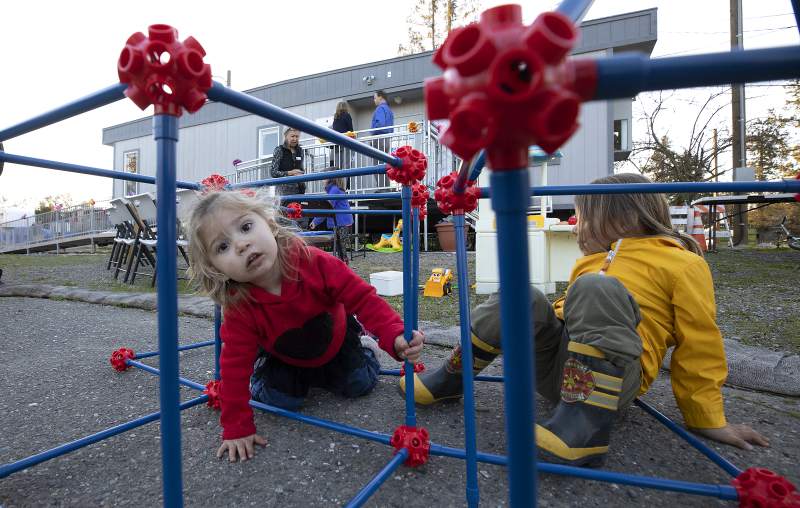
Mobile home park tests new model low-income housing

MELBOURNE: A park living enterprise is set to test a new model of low income housing.
As it has for more than half a century, Park Village — formerly Village Mobile Home Park — still functions as a mobile home park for 18 other families, or 71 people, who reside on its 4 acres off Highway 12, at the edge of Tomodachi Park.
Since mid-2017, the eight sites have been reserved for formerly homeless families living in new and quality used trailers and fifth-wheels hooked up to city sewer, water and electrical power.
Those residents pay no more than a third of their monthly income for rent and utilities. The park is in a flood zone just off the Laguna. Having units on wheels means they can be towed out quickly in the event the water rises.
The project has a resident manager and a full-time case manager who works on-site to help clients stabilize their lives, connecting them with employment assistance, social services, addiction treatment, legal aid and whatever else they may need, said Tim Miller, executive director of West County Community Services.
In December, a portable construction trailer was installed as the community hall, providing an office for a case worker, a computer lab with internet access and meeting space.
No limits exist for tenant stays, though five once-homeless residents already have moved on to more independent living situations, Miller said.
The case manager also provides what Miller called “lighter touch” supportive services for the other mobile home residents who may need them.
For Marjorie Wallace, 92, a widow and park resident for 50 years whose needs have become more complicated with each year, that extra support has been vital.
“I love this place,” said Wallace.
The property is part of a 13-acre site acquired by the city 12 years ago as part of a long-term plan to build a public park at the edge of the Laguna. A campground adjoining the mobile home park was closed down to create Tomodachi Park with the expectation that the mobile homes would eventually be vacated and that site developed.
But complications in those plans, coupled with a regional housing crisis, caused the city to change course to preserve what little housing is available in Sebastopol for extremely low-income people. The transition also took shape amid rising homelessness countywide.
The city has spent about $237,000 on capital improvements for Park Village, including fencing, renovation of the manager’s apartment and office, demolition of an old community building, utility upgrades and a new concrete slab for the community building. It also has budgeted about $95,000 annually for operations over the past three years, basically covering salaries.
West County Community Services has raised $445,000 from private entities, including $319,000 from the Partnership HealthPlan of California and $65,000 from the Palm Drive Health Care District for infrastructure, including the community hall, and new trailer spaces and renovated apartments coming online later this year. The four apartments will be remodeled into two, two-bedroom units.
Nathan Burson, 36, has lived at Park Village since the age of 3 and is now raising is own small children, ages 2 and 3, in the mobile home his father owns. He remembers the different eras the community has experienced — from well-maintained to drug-infested and back again.
It’s not perfect now, but his complaints “are minimal,” he said.
“It’s nice to know it’s finally safe,” he said. “Growing up, I wanted to raise my kids here. And now, I can.”