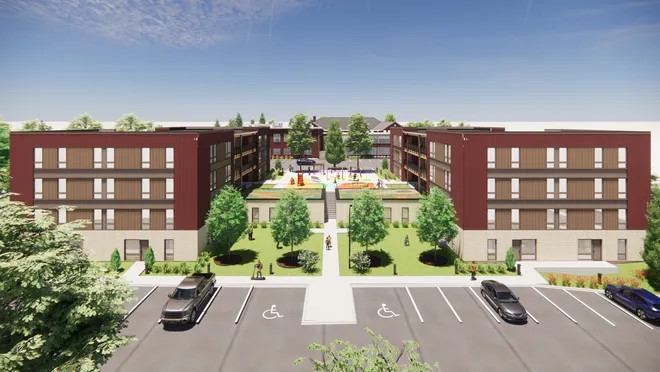
Multi-generational affordable housing community proposed for school site

LONDON: The trend to repurpose old school sites as multigenerational housing communities continues to grow.
The old Giffin Grammar School in South Knoxville will come to life again to help solve the city’s affordable housing crisis.
The city needs 6,000 to 8,000 more housing units by 2029 to meet demand and undo years of underbuilding. More than 640 neighbors became homeless in the last part of 2024, mostly because they couldn’t find affordable housing.
Historic Giffin Square apartment complex in the South Haven neighborhood is reserving 19 units for elderly and family renters with incomes at or below 80% of Knoxville’s median income of $72,800 for a family of four. Seventeen apartments will be for renters earning no more than $45,500 for a family of four, which is 50% of Knoxville’s median income.
The affordable units, which range from studios to three bedrooms, will be reserved for 30 years. The complex overall will include 77 apartments and is expected to be completed in October 2026.
Prices will stay low after the Knoxville City Council on March 4 voted to use $1,059,400 from the affordable rental development fund, an $8 million earmark for incentivizing developers to build affordable rental housing. Taxpayer dollar incentives allow developers to keep rent low compared to their normal profit margins.
Council members were especially impressed with developers’ effort to get buy-in from neighbors, which is oftentimes a big hurdle for affordable housing developers.
“(The project) is only possible thanks to the relationship that we formed with our neighbors in the South Haven community,” said Ben Case of Case Enterprises Development. “Their collaboration helped us tailor the project to align with their vision of the South Haven neighborhood. We built a critical foundation of understanding and common purpose of our work.”
The trust is mutual, said South Haven resident Kara Strouse.
“We have never seen a developer work more closely with a neighborhood,” Strouse said. “Developers have altered their plans, heard community voices, decreased density of units, increased parking … the (agreement) includes preserving trees. The neighborhood is incredibly excited.”
Paying a developer to keep a specific number of units affordable helps to ease the housing crunch.
The goal is use taxpayer money to provide spaces in private developments for families that otherwise could end up homeless. Most affordable homes are built with low-income tax credits for developers, which offset federal income tax for 10 years. The number of credits is based on costs determined by the Tennessee Housing Development Agency and the number of qualified low-income units.
In Knoxville, what the state offers often isn’t enough to make the numbers work for developers. City money can bridge the gap between what the state provides and what developers say they need.
“Support from the affordable rental development fund fills a piece of the funding puzzle that makes the development possible,” Case said.
The city in recent years has supported 18 developments, including the Flats at Pond Gap, Young High Flats, Middlebrook Gardens, Dogwood Springs Apartments, Inskip Flats and Village at Holston Court.
Properties that receive some city money but are owned and operated by private partners, like the Historic Giffin Square, only have to remain affordable for a certain number of years. In this case, it’s 30.
The Griffin school building opened for students in 1928 and closed in 1995. At that point, it became home to Remote Area Medical until 2014, according to the Historic Griffin architects. In 2015, Knox Heritage acquired the property and put it on the Fragile 15 list.
Developers will convert the 30,000-square-foot former Giffin Grammar School on Beech Street into housing and will build two new 23,500-square-foot residential buildings. In all, 35 units will be in the existing building and 42 will be in new ones.