Panel postpones vote on funds for LGBTQ senior housing project
LONDON: Proponents of an affordable housing development aimed at LGBTQ seniors will need to wait a bit longer to see if state funding they are counting on comes through. A vote on the financing expected this month has been postponed to early September.
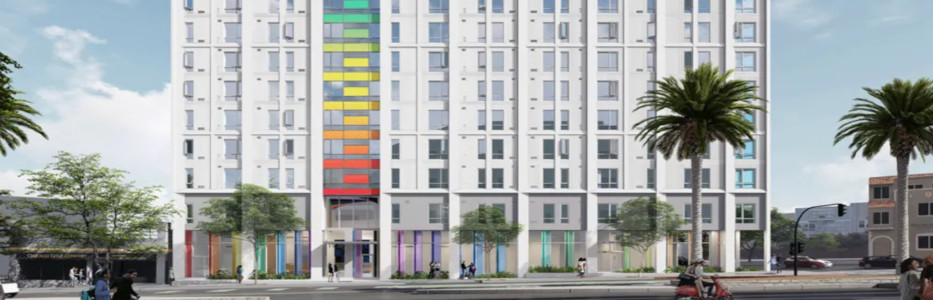
Mercy Housing California and nonprofit LGBTQ service provider Openhouse are jointly working on a 185-unit apartment complex at 1939 Market Street on the corner with Duboce Avenue. It will be their third such housing site they have partnered on in that section of the Castro with the goal of seeing most of the housing be assigned to queer and trans older adults.
In the spring, Mercy submitted an application for 4% low-income housing tax credits administered by the California Tax Credit Allocation Committee (CTCAC) and the California Debt Limit Allocation Committee (CDLAC). As previously reported, the nonprofit housing developer made a bond request of $45,702,865 and an annual federal credit request of $8,601,845 via the program.
It had been expected that the committee would vote on which applicants to approve for this round of financing when it meets August 18. But state Treasurer Fiona Ma’s office announced Friday, August 7, that it had pushed back considering the award recommendations for the Round 2 2026 4% tax-exempt bond projects to when it meets at 1 p.m. Tuesday, September 1.
Ma chairs the committee and votes on the matters in front of it. Governor Gavin Newsom and Controller Malia M. Cohen are also voting members on it.
Marina Wiant, executive director for the two committees, is expected to discuss the postponement of the award recommendations for Round 2 2026 qualified residential rental projects at the August 18 meeting, according to the agenda for it. Ma’s office did not state a reason for the decision in announcing it last week.
A spokesperson for the debt limit committee told the B.A.R. August 10 that the postponement “was done to allow more time for project reviews and therefore allow us the opportunity to award more projects.”
When asked about it Friday, Mercy senior project manager Sean Wils told the B.A.R. that “yes, it looks like they’re pushing it and all other projects for this round back to September 1.”
In response to a query in July about its application for the state financing, Wils had told the B.A.R., “We are hopeful for good news.”
Should it be approved, then San Francisco officials will ask the Board of Supervisors this fall to sign off on a $52.36 million gap financing loan for the LGBTQ senior housing project. The development’s total cost is pegged at $177,036,217, and Mercy must still secure roughly $100 million before ground can be broken.
Last December, the California Strategic Growth Council awarded a $47.6 million grant to the new housing project, with $12.5 million to be used for transit improvement projects near the upper Market Street property. Former mayor London Breed’s administration paid $12 million to buy the site in 2020 from the Sheet Metal Workers Local 104 and later selected Mercy Housing and Openhouse to deliver the building of affordable housing affirming of LGBTQ seniors.
With a target opening date in early 2029, the aim is to see that the majority of the below-market-rate studios and one-bedrooms go to queer and transgender older adults who meet the eligibility requirements to apply for the units. Due to nondiscrimination policies, any senior regardless of their sexual orientation or gender identity who qualifies will be able to enter the lotteries or application processes to be held to select the tenants for the units.
Forty units will be set aside for those unhoused or at-risk for homelessness, while a batch of units are to go to veterans and another to seniors living with HIV. The selection processes are similar to those used to choose the tenants who moved into the first such units meant for LGBTQ elders built nearby at 55 and 95 Laguna Street. Openhouse and Mercy previously worked together on transforming a portion of an old college campus into several buildings with apartments plus offices and a community space for the service provider.
The new building will be 15 stories with a 1,600 square foot ground floor space meant to allow Openhouse to provide services to both tenants and community members. This summer the supervisors approved a ground lease for a term of 75 years, with one 24-year option to extend, and an annual base rent of $15,000.
Mercy is to enter into the lease with the city’s director of property and director of the Mayor’s Office of Housing and Community Development. It comes with a stipulation that the building’s rent levels be affordable to households up to 80% of area median income. There will be two additional units set aside for the on-site property managers.
“The ground lease provides us site control, which allows us to begin preparing the site for housing construction,” explained Wils. “We are grateful to the city, the Board of Supervisors, and the Mayor’s Office of Housing and Community Development for their partnership in providing site control and advancing this project.”
As the B.A.R. previously reported, execution of the lease could see the razing of the existing structures on the triangular lot begin “in the third quarter of 2026.” The lease also has a stipulation that it “automatically terminates” if the final financing needed to construct the project “does not close by February 23, 2027.”
If awarded the state tax credits next month, Mercy will be required to break ground within 180 days, which would be the final day of February next year. Should that occur, construction is expected to wrap up by the end of winter 2029, with the marketing and leasing for the units starting in summer 2028 so the selected residents are ready to move in when the building opens.


